Abled enough
Despite encountering barriers, I keep on riding my wheelchair

Check in
Lights and reflections,
Slights and defections:
Where things end up
Might come as a shock.
Anyone could slip on a banana peel. One might at least appreciate its dying form.
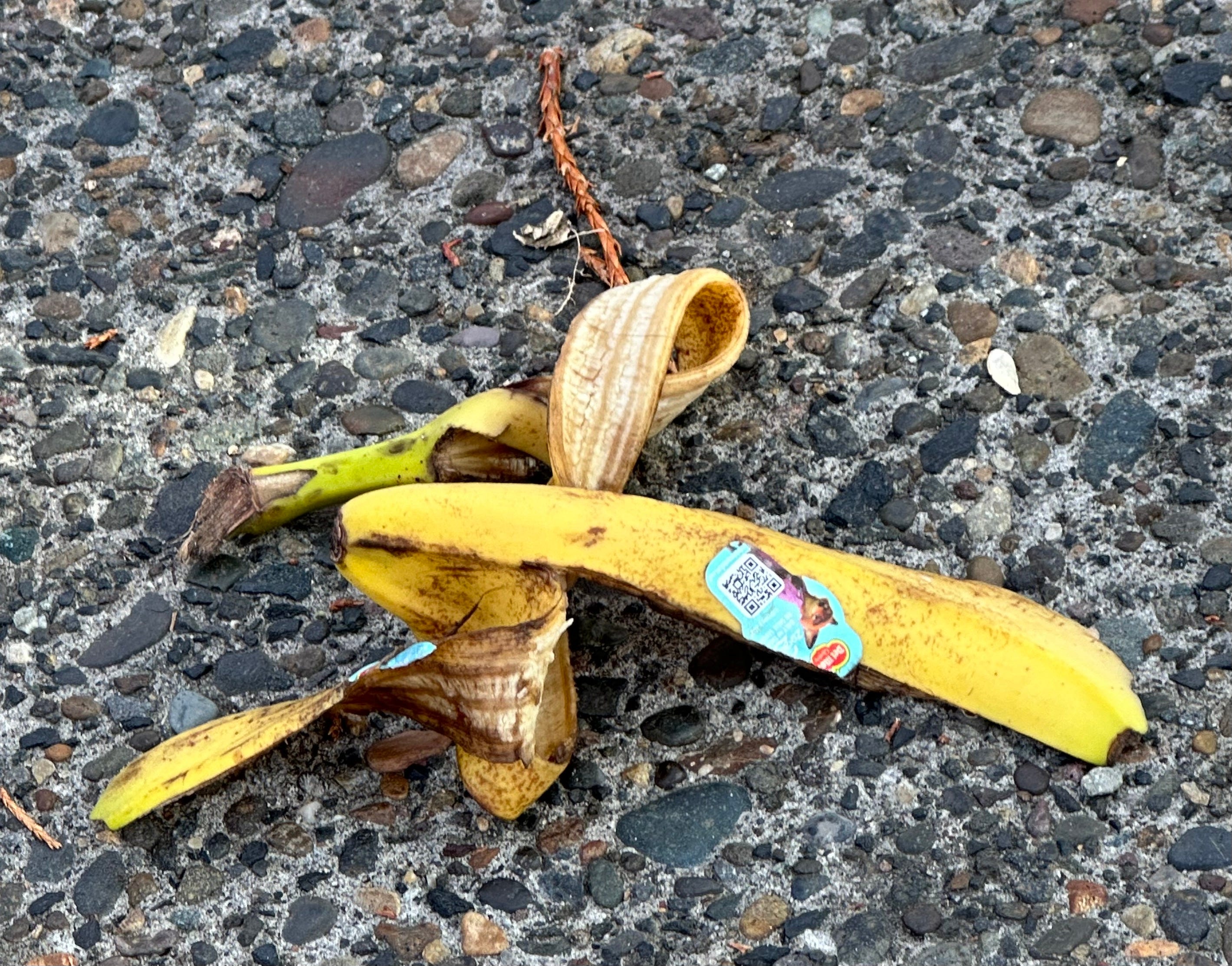
Where the day takes us
We get up in the morning not knowing what the trajectory of the day will be. At least, I never know. I’m retired and have no form to my days other than working on the next Becoming newsletter. I am free to do what I have been calling “bus therapy”—ride the bus, then drink coffee while I write in one of my trap line of cafes.
Each day’s trip presents its decision forks. Which bus to take, where to get off and explore. What foods to buy and eat. How to get to the shops close by on Hawthorne Boulevard: roll in my wheelchair or catch the bus for a handful of blocks.
Distractions
What to read while waiting at the bus stop? Email on my phone, an ebook, or a real book I carry with me? A better way to spend the waiting minutes is to observe what’s going on around me. A yellow car, strange dogs, Safeway customers. The wind pushing the trees sideways and twirling their leaves.
Last week on a bus trip in a rural area, I saw a pile of yard debris in a field. A tangle of roots and branches. For miles, that image stayed with me, creating an arc of memory. Why did that sight move me so? No matter why, it just did.
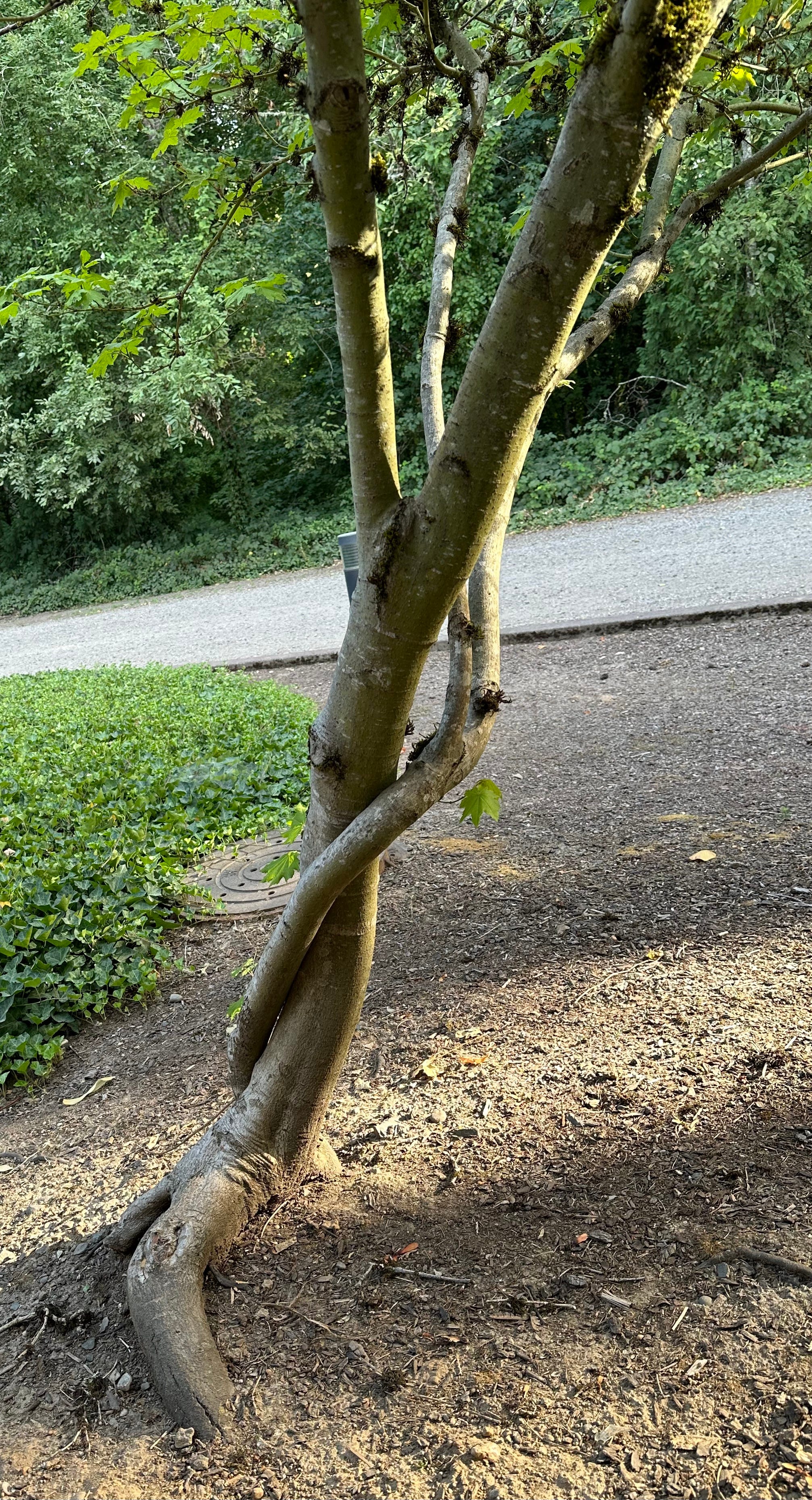
We never know what surprise in a day will move us this way.
And then comes tomorrow.
Every day has its wonders. We open our eyes and enjoy.
Minor rules
Today is a day for breaking minor rules.
Most rules are minor, anyway.
Most rules don’t matter, they’re just the fence
That keeps our egos safe and in control.

Sleeping in, I give up writing time.
Too soon, I leave the desk to brew my coffee.
Breaking the rhythm, I change the cadence.
Rules lay in splinters around me.

Maybe today, I’ll just sit with the trees
And forget all the rules I was meaning to break.
Access
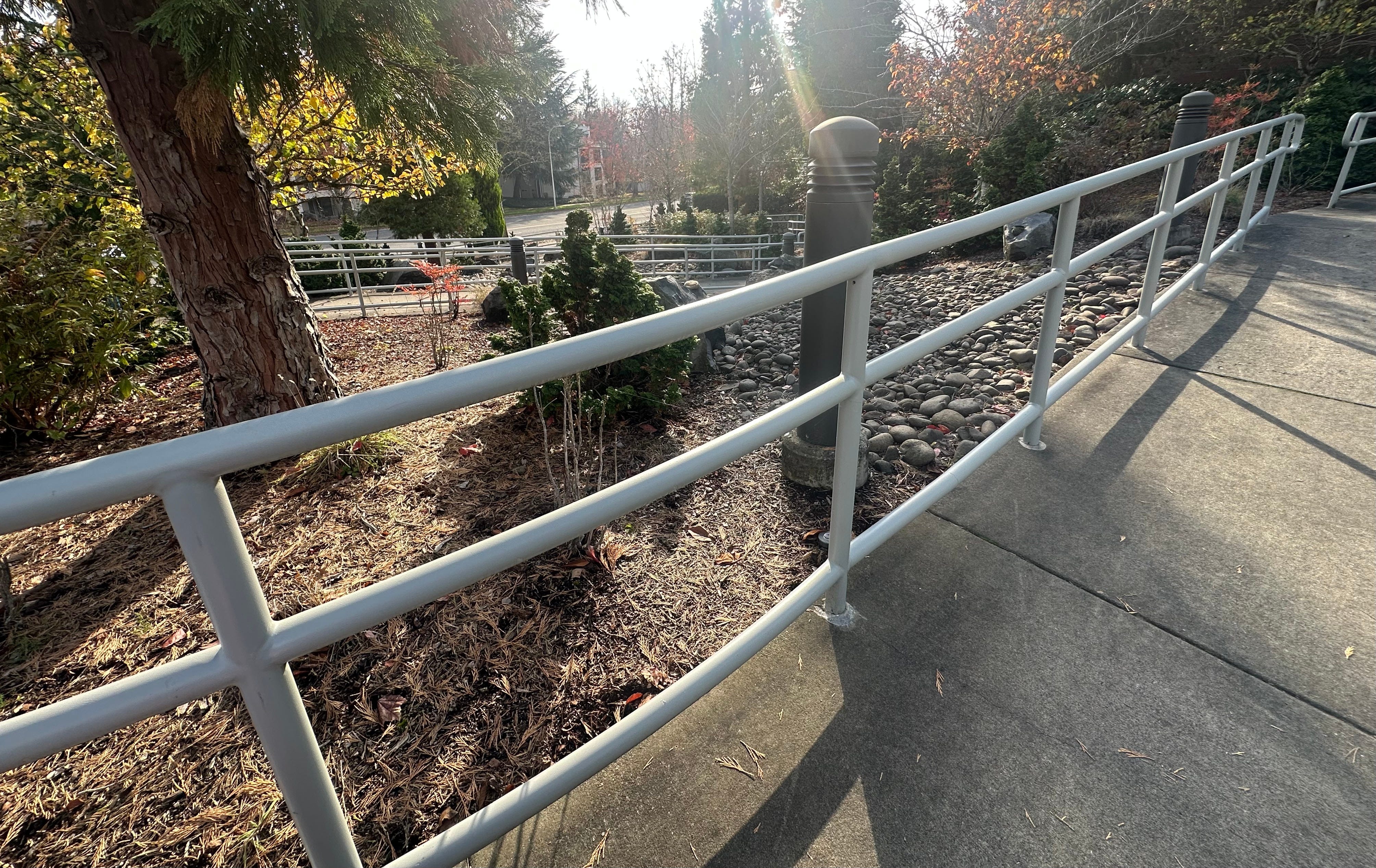
Midway between my diagnosis of multiple sclerosis in the mid-90s and today, in the days when I was walking with the aid of a cane, then a walker, I would joke that I wasn’t handicapped enough. That’s because most solutions to disabled access entail walking relatively long distances. Usually along a ramp that switchbacks down a slope.
Nowadays, I have a wheelchair to navigate lengthy ramps, so they don’t bother me. E Earlier this week I encountered this one at the Kaiser Westside Medical Center. I was already a third of the way down it when I took this photo. Far in the background, you can barely make out a third set of railings.
When I was still using a walker and would come to an intersection where there was no curb cut ramp, I could usually just lift the equipment over the curb to the street. In a wheelchair, though, if there’s no curb cut I need to backtrack to the nearest driveway. Sometimes I just give up on the sidewalk entirely and ride in the street, avoiding the bumpy, broken pavement that is so common in neighborhoods with big street trees.
I like riding in the street. I feel safe on the flat, quiet streets of my neighborhood.
Curb access
Periodically, I contact the Portland Bureau of Transportation to suggest curb cuts. I always get the same response—they welcome suggestions, but there are a limited number of new projects they can do each year.
Some curb cuts need to be constructed soon, like at the intersection of Southeast Morrison and Sixth, near the Morrison Bridge. I’m tired of having to trek halfway down Sixth Avenue to a driveway—and then I have to roll down the street.
In the photo below, proceeding either forward or to the right is not an option. The ramp to the street is steep and scary, and at the right, the pavement is raised so high that the wheelchair might balk at cresting the bump.
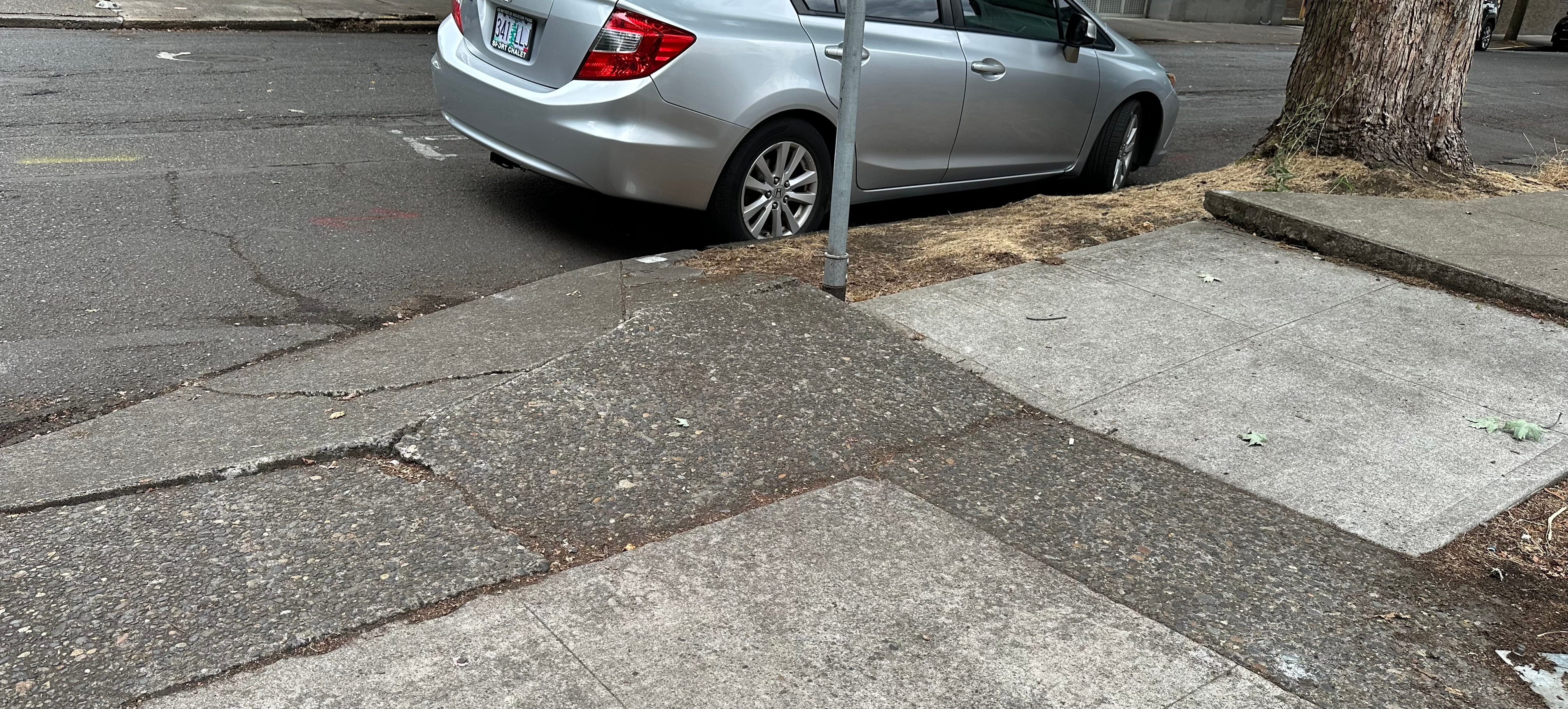
This intersection is at Northwest Park Avenue and Flanders Street. Many of the intersections in the Portland’s West End, the blocks on either side of West Burnside Street between Park Avenue and the I-405 freeway, have corner ramps that are unnecessarily steep. Often the pavement at the bottom of the cut is broken, too, making for a bumpy landing. I avoid visiting Powell’s City of Books on West Burnside because of the poor access.
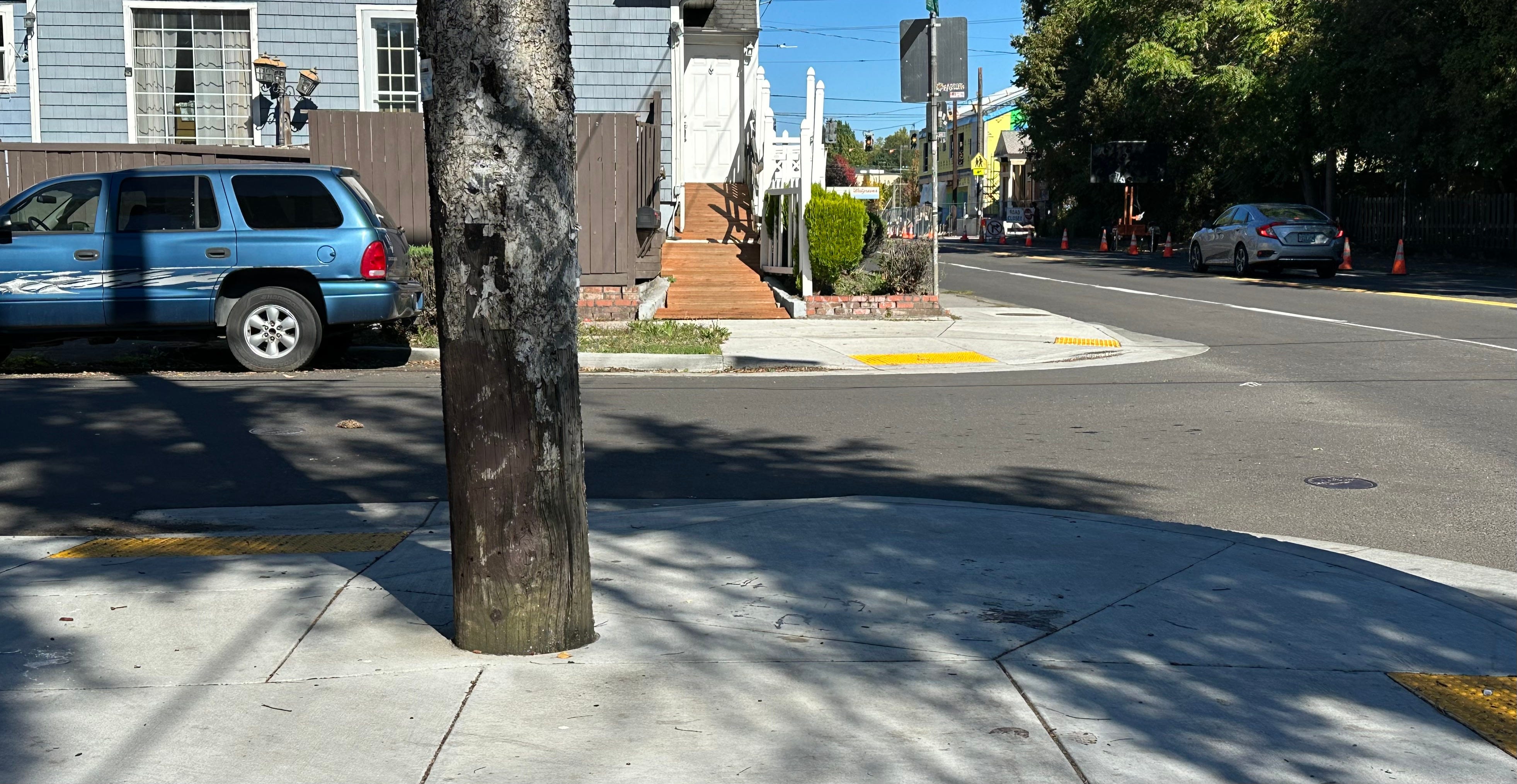
Sometimes there are impediments to proceeding in a straight line, as this in this configuration on Southeast César Chávez where I have to navigate around the phone pole to cross the street.
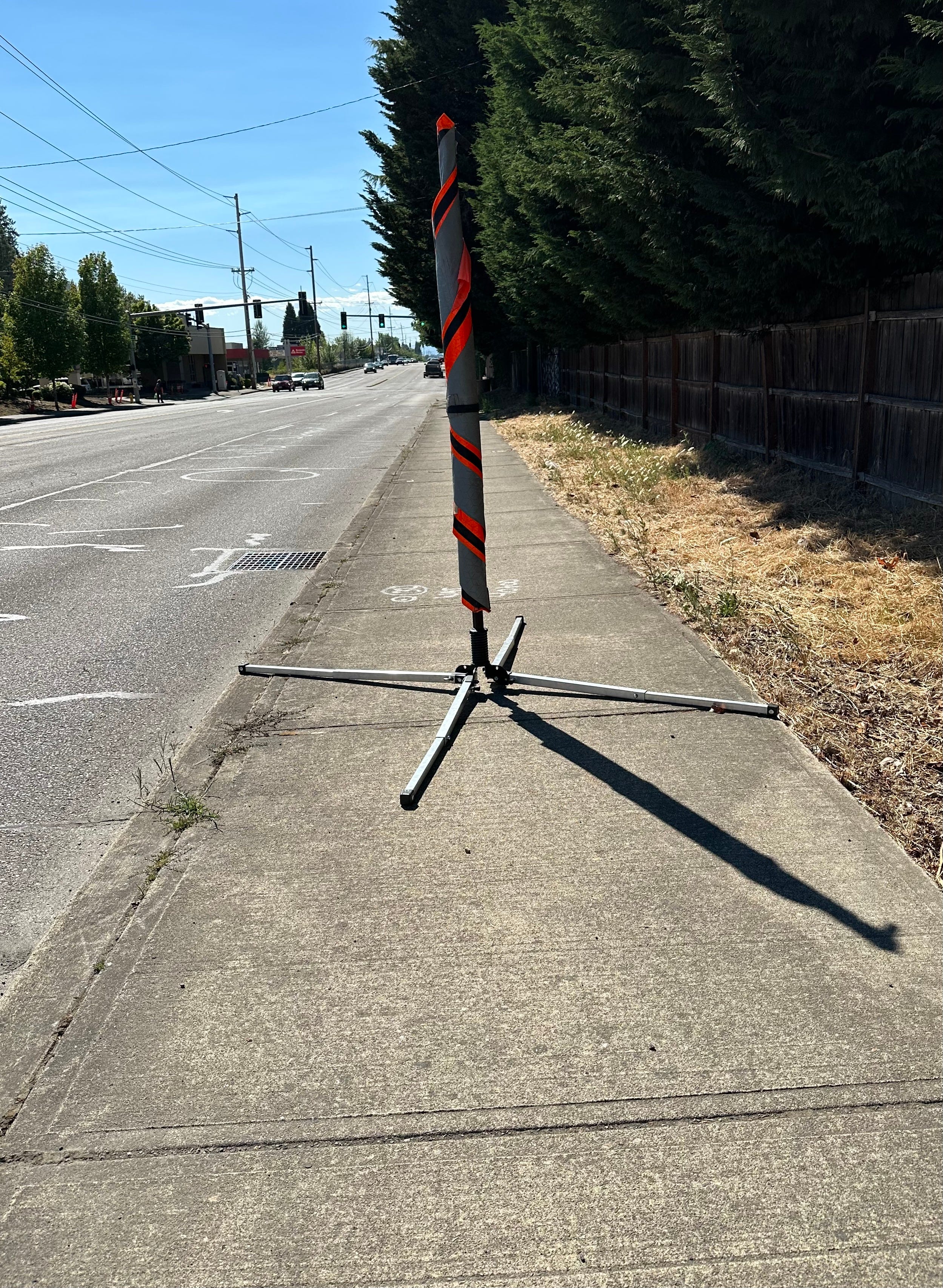
People sometimes park their cars in the driveway but don’t pull far enough in to leave the sidewalk clear. Do they forget that anyone might want to use the sidewalk?
My favorite peeve: it’s garbage day and trash bins are placed right where they belong, in the street, at the end of a driveway. But I’m trying to avoid a huge break in the pavement ahead, and the bins are blocking the driveway I want to use to get to the street. Again, I have to backtrack and go around.
And sometimes people forget that anyone may want to use the street.
Albina Library
On Veteran’s Day, I stopped by the Albina branch of the Multnomah County Library, off Northeast MLK Boulevard between Knott and Russell. I came there totally by serendipity. Finding myself at loose ends in Southeast Portland, I caught the next bus that came along, which was the 6/MLK. I had the idea for this to be a Bus Therapy ride, all the way up to Jantzen Beach. But on a whim, I got off at Northeast Brazee and went to the library.
I was going to write about the disabled access at this library anyway. So why not visit it again? I had my laptop with me and was looking for a place to perch and write.
The Albina Library has a long access ramp at the Knott Street entrance. If you can’t skip up the stairs, you can make the long trek up the ramp.
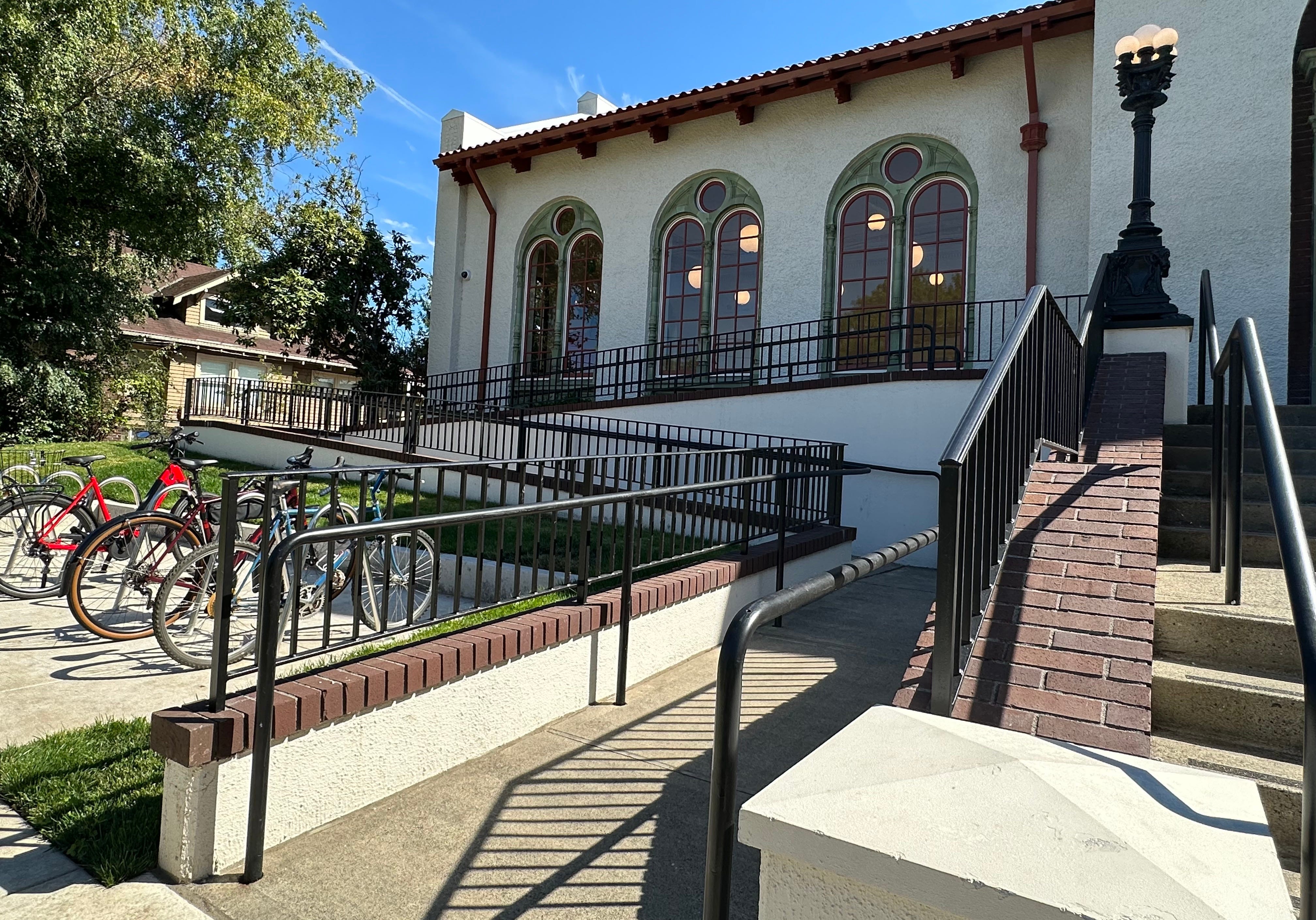
Thankfully, there’s a more straightforward way into this library, on Russell Street, where an elevator whisks you to the main floor.
Full use mode
Inside the library, the joint was jumpin’ but the mood was mellow. Through the windows of the newly renovated building you could see brilliant sunlight, blue skies and the last yellow leaves of fall.
Inside, I enjoyed the vast differences among the people at the library, which was comfortably crowded:
The neurodivergent teen swaying and humming along with the anime he was watching. Boomers with reading glasses ensconced with their books in green leatherette armchairs. All manner and conditions of folks using the Internet stations: bright-eyed students, studious professional types. Younger kids, too, because school was out for the holiday.
Library poems
After I had set up the laptop at a sunny table and was writing these very words, a bright, sparkly woman stopped by to say hi. JoAnna and I had met at a coffee shop a few weeks earlier, when I gave her a card with my Substack address. She had been reading Becoming and wanted to tell me how much she enjoyed my writing.
Thanks, JoAnna!
I’ve been itching to write poems for strangers again, and although JoAnna isn’t exactly a stranger, I offered to write her one.
She asked me to write about moss.
Moss
Softer than cobwebs,
Stealthy as cats
Covering shingles and weakening roofs.

Born of the moisture
Of Oregon’s second season,
Rain and mist its companions—and rocks in the stream.
Meanwhile, a man, David, greeted me from one of the green armchairs. David and I have met at Ikoi no Kai, the Japanese-Hawaiian lunch program at Epworth United Methodist Church just around the block from where I live. I offered to write him a poem, too. He said to write about anything. I chose November.
November
Wingbeats of November,
Seagulls and Canada geese,
Gathering swallows,
Trembling dead leaves.

Storms tear the leaves,
Pull down the pinecones,
Ruin the fall pumpkins
And drive us inside.

What we ask of November:
Please keep us warm,
Well-fed at Thanksgiving
And protected from storms.

Gifts from November:
The advent of winter,
The first frosty midnight,
The last suns of fall.
*On Nov. 8, 2023, I published “No,” a favorite poem about November by the 19th century English poet Thomas Hood. Find it here, in a posting that also features candy dots and more poems written for strangers.
I write poems for other people in my journal, then make a neat transcription to give away. In the library, I parked my wheelchair, with my writing in my lap, near a computer station where I fell into conversation with the woman working there, Natalie. I offered to write her a poem, too, and we decided on the sober topic of trials and troubles.
Trials and troubles
Finding a place to live,
Gleaning fall’s harvest.
Thinking of good times—
Just now, maybe later.

We’re told to hope,
Keep you in my prayers.
But nobody knows—
The next step may falter.

We hope, we forgive.
As each new day invites us.
New trauma, new drama,
New strength in our purpose.
Check out
Overload
In the article above, I wrote about physical obstacles facing people with disabilities.
One other obstacle I face each week is that I invariably write more than I have space to share with you. Every week, I cut interesting or useful stories from the final draft. Some will turn up in subsequent postings; others are left on the cutting room floor.
So often, synchronicities pop up to fatten my output. This week, for instance, I happened to find the long disabled ramp in the photo above after visiting my neurologist at Kaiser’s Westside facility.
More connections followed my riding down that ramp:
I missed the bus that went back east toward Beaverton (toward home), so instead I took the 47/Main/Baseline bus, a route that included several stops in Intel’s vast Ronler Acres campus. The ride ended at the Hillsboro Transit Center, where I switched to the 57/TV Hwy/Forest Grove bus going east, back toward Portland. The 57 let me off in Beaverton, where I visited two eateries I don’t have room to write about this week. Check back next week for a story on Pho Oregon, Pho King Good, and King Donuts. Till then, notice how the three business names relate to one another.
Last statement
As always, I bow in appreciation to my lovely readers. Thank you so much for subscribing and reading and commenting.
I wanted to write about access for a long time. I’d been collecting these photos for months, keeping track of the obstacles I encounter every day while on Bus Therapy trips or just jaunts in my own neighborhood. You could say the universe led me to these images—or led them to me.
As I noted above, every week, each day, synchronicity takes me by the paw and pulls me into new adventures. It’s so exciting to share them with you.
Till next week,
—Fran
—30—
Fran, I loved this, thank you for writing about access, for letting me see the world through your eyes, through your gifts of writing and close observation, captured in photos. I wish there weren’t those impediments on the sidewalks for you, and glad you are advocating the city for better solutions (even if it doesn’t always work). How fun you’re writing poems for people, too! I especially loved this: ‘We never know what surprise in a day will move us this way.
And then comes tomorrow.
Every day has its wonders. We open our eyes and enjoy.’ Words to live by!
Has the issue of insufficient curb cuts and other barriers to access been covered in the local press? If not, you’d be the perfect person to do it!!!