Big trees. Really big trees.
Many Portland behemoths are more than 100 years old

Check in
Three words
Sometimes I find a trio of words to write about. Today’s three words are mildly related. Why did I pick them? Because. Brio came to me in the shower and the other words followed.
Brio
Biro
Brioche
Brio
Some days I have lots of brio, sprightly energy. The term is associated with music, where “con brio” means to play with vivacity. Thank the Italians for this fun word.
Biro
The British don’t write with ballpoint pens. They use biros. The name comes from the inventor Lazlo Biro, a Hungarian who fled the Nazis, landing first in France, then Argentina.
According to a fascinating essay at the Pen Vibe website, Biro got fed up with the fussiness of fountain pens (cartridges hadn’t been invented yet). He came up with a retractable ball-bearing system and figured out the right ink to use with it.
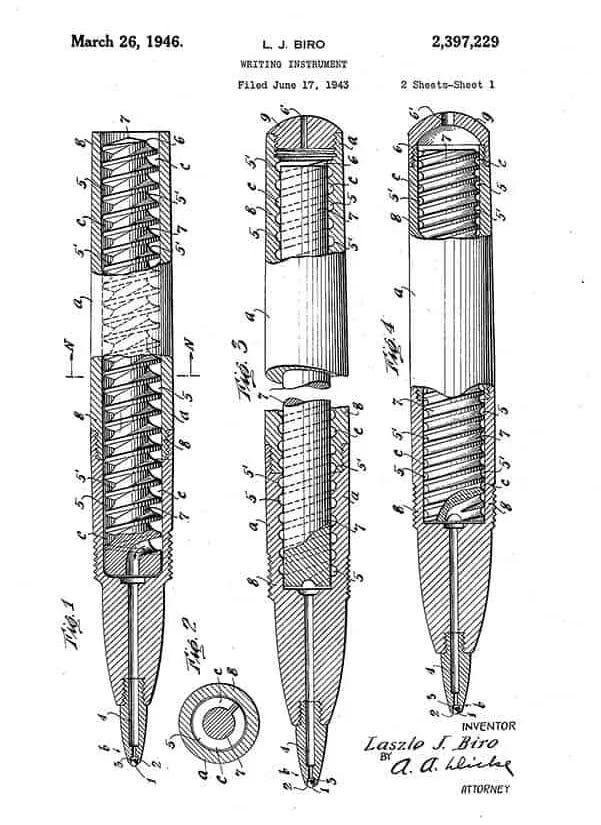
Biro sold his French patent in the late 1940s to a man named Marcel Bich. Bich improved on the design, creating a clear plastic tube that closed the tip with a cap rather than with a spring clicker. He dropped the last letter of his name and started production of the Bic pen in 1950.
Brioche
Brioche is a French bread made rich with butter and eggs. It’s a soft and yielding as a baguette is hard and chewy. The little round individual bun with a knob on top is brioche à tête. Have brioche for breakfast, a treat with more butter—and jam! And a side of café au lait.

Big trees
In my Portland neighborhood, Buckman, most of the housing is about 100 years old. And so are many of the trees growing here, some in people’s yards but most in their parking strips.
I wonder if those early homeowners knew how really big a tree can tower, or how the growing roots might crack and sway the sidewalk pavement. No matter. Big trees are everywhere in my town. And how glorious they are!
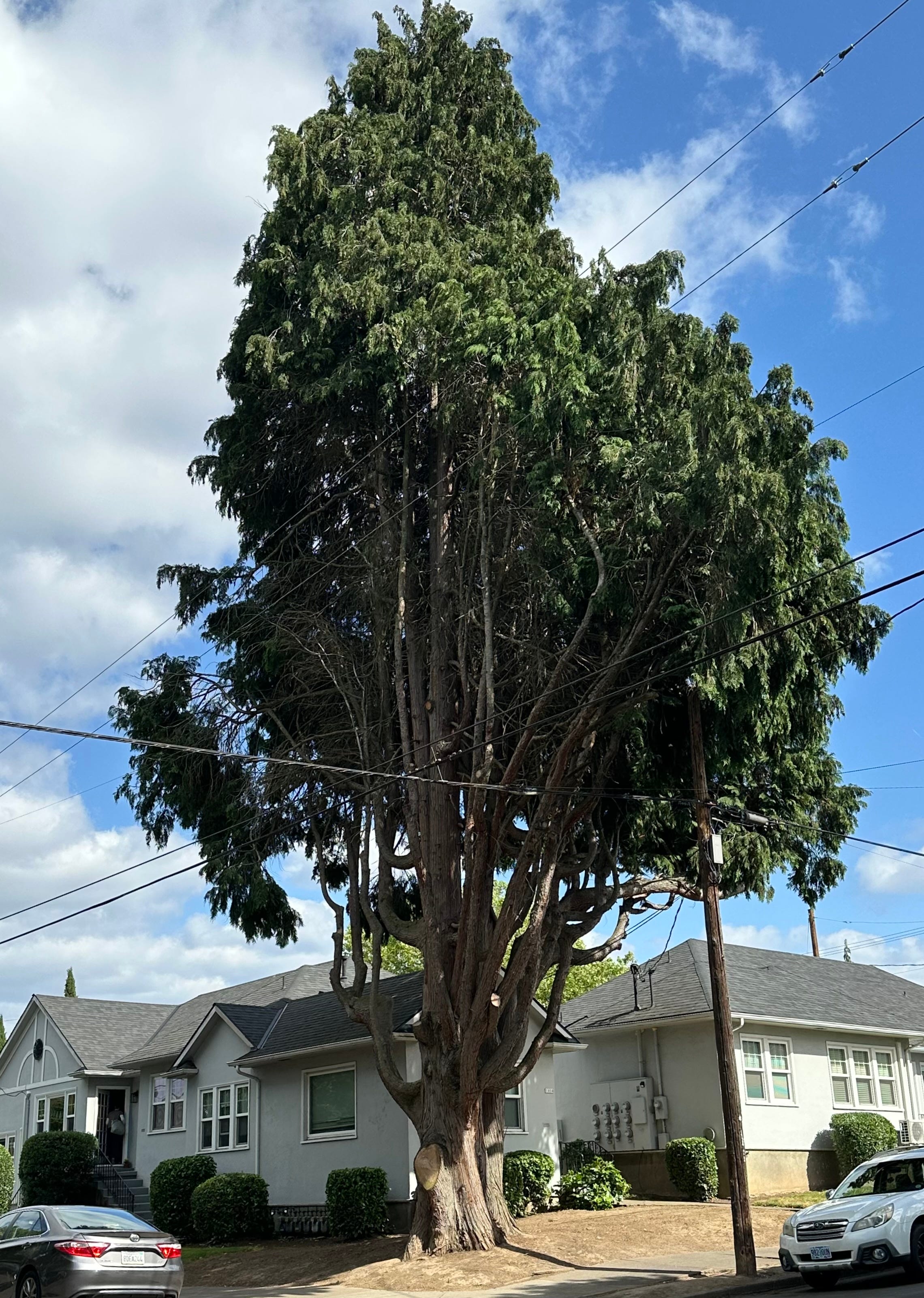
Two blocks from where I live, an aged cedar towers over an apartment building.
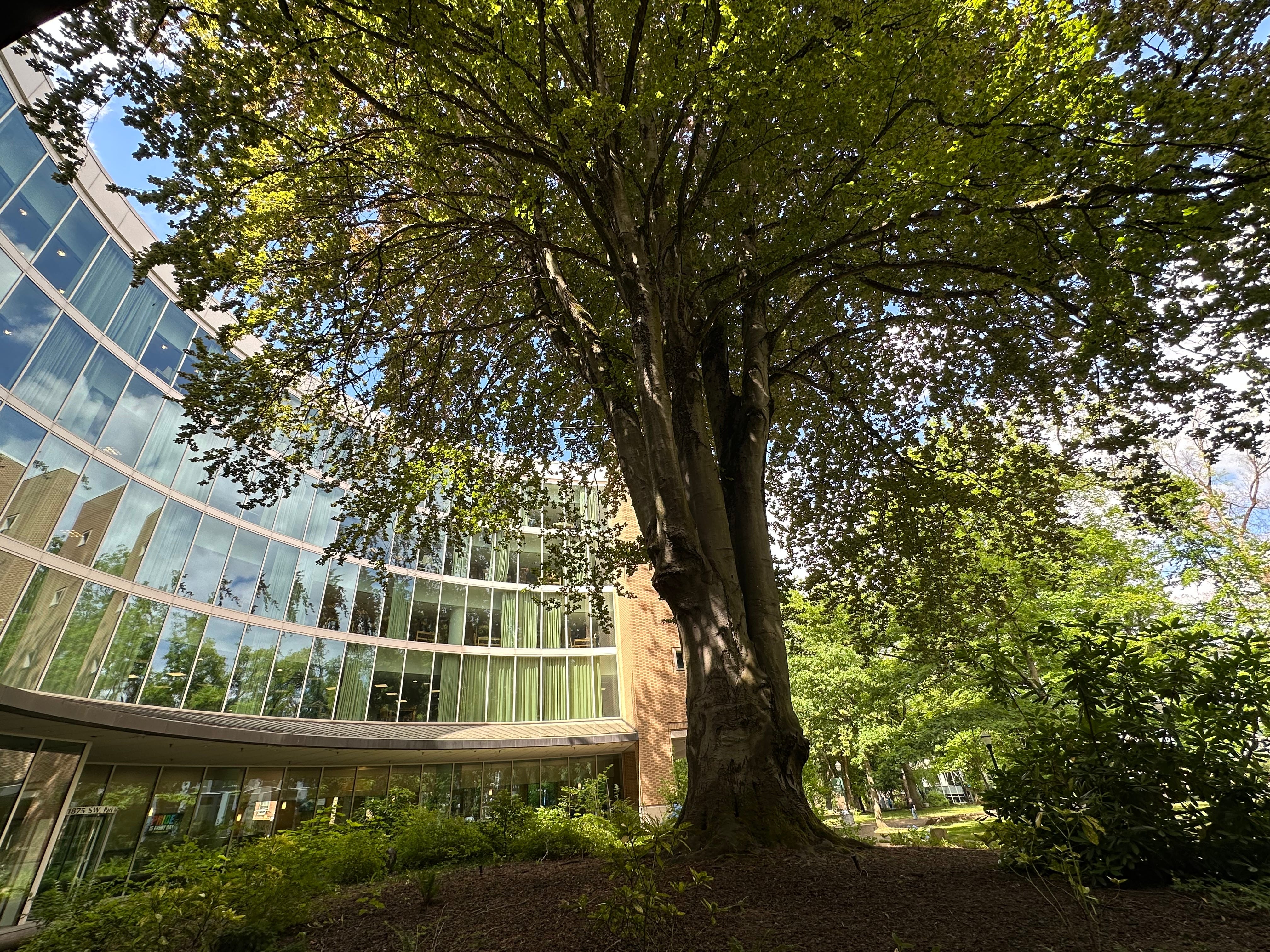
In downtown Portland I found a copper beech planted in the 1890s by Joseph and Mary Watson on land that later became a part of the Portland State University campus. The Branford Price Millar Library was designed and built around the tree. Inside the building, which is open to the public, you can sit at a window and read or work with the copper beech as your companion.
Replacing trees
As trees age and rot and succumb to disease and pests, the city of Portland, which owns the parking strips and has a say on what gets planted in them, has many suggestions for street trees that are not as big. You won’t be able to replant that heroic elm, showy horse chestnut or branchy catalpa.
We had to replace an elderly weeping birch that fell victim to a birch borer infestation. The city gave us two trees, one of which is a thriving redbud that’s decked out with heart-shaped red leaves all summer.


The Norwegian connection
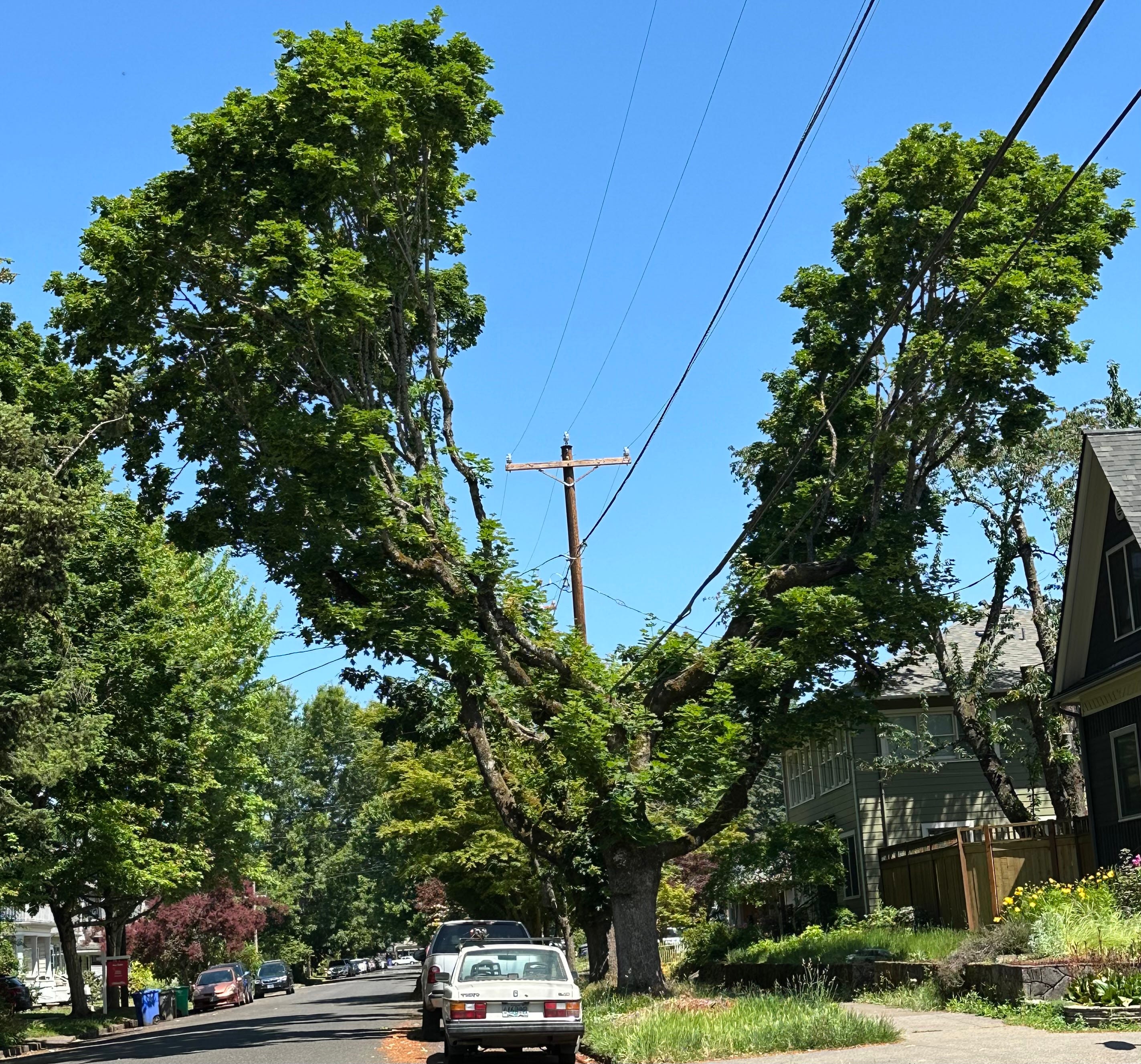
Norway maples were a great favorite with the designers of Portland parks in the early 20th century, but they are out of favor now because they seed so copiously and crowd out native species. Plus, they are big, growing as high as 90 feet.
A common species in Washington Park, Laurelhurst Park and elsewhere, they are now on the city’s nuisance plant list. You cannot plant one anymore.
I took the photo of a Norway maple on Southeast 35th Place because I was intrigued by the hole cut in the foliage to keep utility wires clear. It looked a bit like a heart.
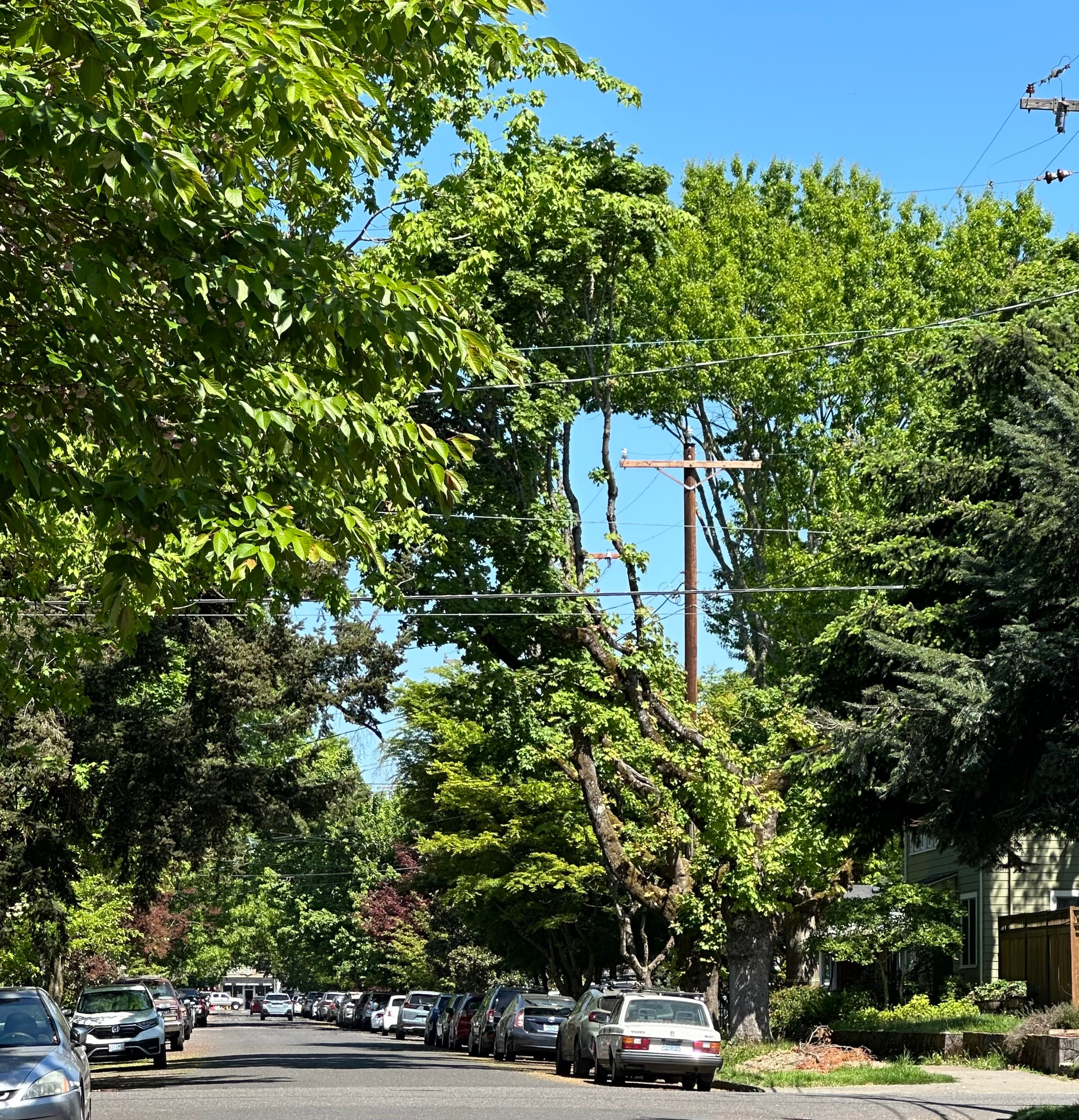
A week later, I visited the tree again to doublecheck the species—it is indeed a Norway maple—and found that utility workers had further mutilated this ancient individual.
You can find large trees all over Portland, in Ladd’s Addition in Southeast, Laurelhurst in Northeast, Arbor Lodge in North. They tower over the unpaved roads of East Multnomah County. The firs on the west side of the Willamette River tend not to be as massive, as many of the conifers are second-growth.
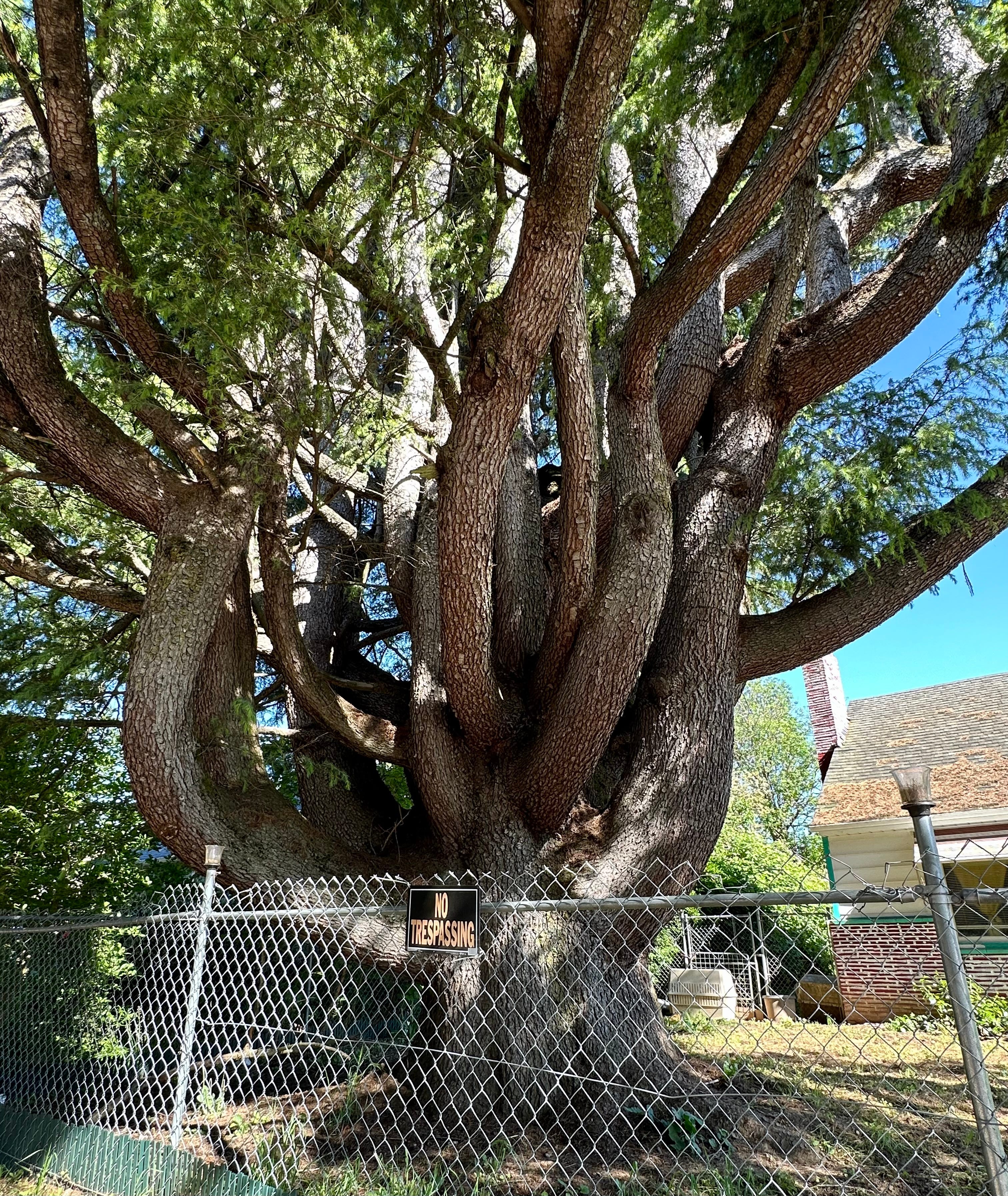
I took a lot of photos of very big trees, many of them within a block of my home. Then I got off the bus at Southeast 135th and Harold to photograph this multi-trunked pine. I’m fascinated by how the trunks twist and twine, like the tree is hugging itself.
It’s sad, in a way, that the next generation of trees won’t be as tall, but at least the city’s list of trees is varied—and the city will help with the cost, too. It’s in everyone’s interest to have a vibrant urban canopy.
Street ready
So if you own a house and need a tree, this is the time to plant one. Well, actually, fall is the best time to plant. The Portland Bureau of Parks and Recreation provides a list of acceptable trees and info on how to get them planted for free. Each year, they select a large handful of neighborhoods to plant. Click that link to see if yours is on the list.
The city explains its philosophy as “prioritizing species that are low-maintenance, climate-resilient, and well-suited to the planting site. These trees are chosen to thrive in the space, support neighborhood health, and mitigate issues with existing infrastructure.”
A free tree! Think of all the shade, the birds, the happy squirrels and the peeing dogs.
Help keep Portland leafy.
Check out
Lost in the basement
I can navigate the stairs to the basement, with some difficulty. But I haven’t descended them for many months now. I know I need to be sorting and culling the accumulation of decades. It just seems so daunting.
Robert went down in my stead and took some photos.


My netherworld
The basement beckons with Stygian call:
Come now, come visit, see all your stuff.
Decades of cast-offs yet things that I value
When did I ever think things were enough?

What do we own, really, as life’s end approaches?
Our life force, our essence, our bodies, our brains.
What we have with us, not things of the outside
The cream, not the crumbs, not the dismal remains.

Toss things or give away, keep just what is needed
When we start sorting, we find need is not much.
Move things from the basement into our memory—
Like tasting that candy bar I never can touch.

So down to the basement, keeper of stories,
Quartermaster of all my discarded things
You hold my memories, but so does my body.
Cull much, keep little. See what time brings.
Farewell for today
Sometimes I think of all the things I could be doing if I were not writing every week, but I like writing the best. I write at my desk in the early morning and, as you, dear readers, know, at coffee shops later in the day.
Money is recognition, in its way. Use the button below to buy a yearly subscription. It costs less than $1 a week. Or dip your toe in the water for $5 per month. On PayPal, you can tip me in $5 increments.
Meanwhile, if you enjoyed this post, click on ♡ to let me (and the Substack universe) know. More and more readers are doing that every week, and I so appreciate it!
206 weeks of writing
If you have time, which most likely you do not, but still—you might take a wander through the archives at Becoming. Hit the “show more posts” button and dive down a few months or years. Pick something at random. I promise it will be worth it.
I occasionally revisit one of the scores of posts I’ve published, and I’m still pleasantly surprised by the writing. And I am a critical person.
Till next week,
Fran
—30—
Interesting that the electrical workers told you that underground power lines weren’t feasible in the inner city. 100% of Manhattan’s power lines are underground. The outer boroughs are a mix, but even there, the majority are buried. It’s one of the reasons why we rarely lose power during intense weather (unless it floods or a substation blows its cookies). And I love these tree giveaways! NYC has a program too. ❤️🌲🌳
I love trees and take photos of them all the time! There are glorious huge trees in Berkeley, too, and I've been reveling in them. Paris has some pretty spectacular ones too. Thanks for the little tour of Portland trees.