Playing with words
Crafting a poem for healing and finding a word for the year

Check in
Word of the day
Words come to me, dropped into my lap as if by angels. Today, one of the words dropped was “assuage.”
Assuage: to make better, easier, less hurtful.
Assuage is a word that goes along with healing, forgiveness, grace. A January word. Pulling us forward toward longer days, warmer times. Making it all better.
Alleviate. Allay. Assuage. Concepts that help us move more easily, climb higher, remember clearly—without rancor, regret or shame.
Assuage. What a warm teacup of a word! Wrap it around you today, a shawl knit of love and comfort.
A healing poem
At Tuba Christmas last year, I wrote a poem for Jennifer. This week, she called to tell me she had been in a horrific accident on New Year’s, run over by a pickup in the parking garage where she worked. She broke multiple bones and was unconscious for four days.
She asked me to write her another poem, about healing.
Heading toward healing
Pain, my friend, my enemy,
Strength, the grit of my soul.
Recovering now, the long trek,
The healing, the waiting, the grief.

Time you have, time you must take.
Healing of bones and body.
Healing of hatred and disbelief,
Healing, forgiveness, compassion.

You did nothing wrong.
You are not a victim
You are the subject, that is all,
Of a story that went awry.

I see a squirrel fall off a wire, 20 feet.
Poor fellow, I think.
Then he gets up, shakes himself and trots off.

Above us the birds, fearless in the sky,
Knowing nothing of pain,
Flap away, skimming the wind.
Comfort and hope
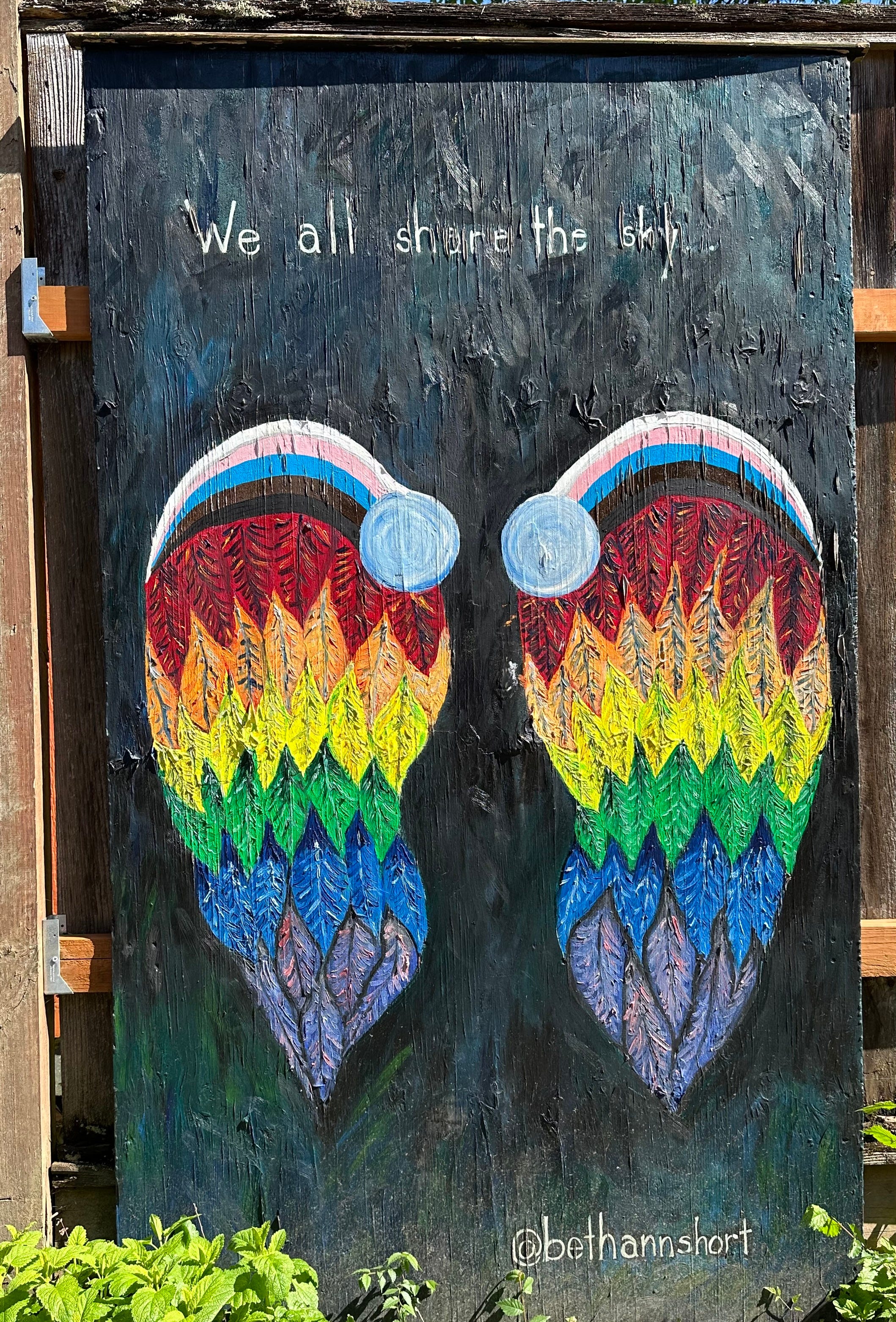
Angel wings decorate a gate in an alley in Portland’s Ladd’s Addition. Alleys are rare in Portland but fun for me to explore when they are paved. The downside of alleys for a person in a wheelchair is that there are no driveway curb cuts out on the street, so if I start down a long block, I’m committed to the next corner, broken pavement and all.
Word of the year
It’s a popular thing these days to choose a word for the coming year, a term that expresses a personal goal.
Although I’m usually not on board the “everybody’s doing it” bus, this year I went along. And the word I came up with is “confident.”
I have a difficult history with this word. Confident certainly does not describe little Francie Pollak who was afraid to take up space. I used to wonder if I was shy, but that wasn’t it. I was just . . . inward. The world was immense, and I was . . . not.
I remember in my early twenties watching a Cary Grant movie—he’s my favorite actor of all time—in which he strides confidently across a spacious marble atrium. It’s the entrance to someone’s mansion. I remember that he is wearing a tuxedo.
It’s hard to confess this, dear reader, but I so clearly remember thinking: how can he just do that? Walk across an empty space as though he owned it? I would have crept along the wall, hoping nobody would see me.
Now the 76-year-old me would confidently traverse that same open space . . . Except, no, I can’t walk unaided anymore. I could confidently push my walker or confidently maneuver my wheelchair—provided the house had disabled access.
The new competence
Somewhere between my twenties and middle age, I figured out the competency of confidence. I came to understand—to know—that it is all right to take up space.
Now I can speak or cantor a psalm or play my violin in public, no problem.
And I can write in public, too, no problem. Some new Substack writers find it hard to swim in this comfortable milieu. They dip their toe in and decide the water’s too cold. Or too hot. Or too tepid.
A writer must make a decision to take up space, to demand readers’ attention, to stride confidently into prose, armed with thoughts, ideas, opinions and maybe poetry.
I wish I could say to all the reluctant writers: come on in, the water’s fine!
Roadwork
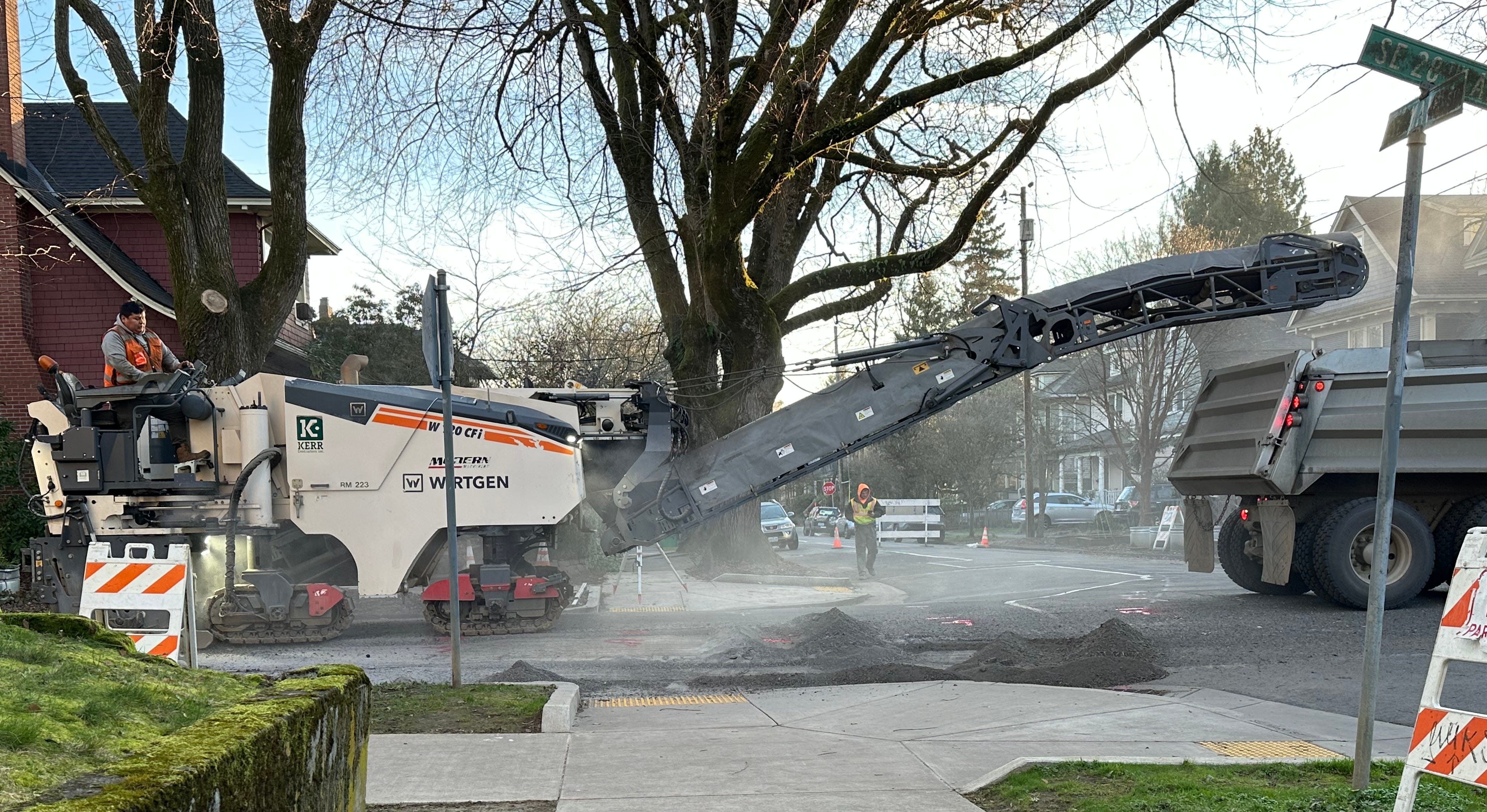
A construction company is repaving an intersection near my house. A woman in a pink safety vest explains: when the street was repaved a number of months ago, following sewer work, the arc, or camber, of the intersection was too high to meet ADA standards. So the equipment is scraping down the asphalt and repaving.
Roadwork
Thank you for fixing the road,
Making it ADA pure
I never noticed the hump,
But someone did, that is for sure.

Next, I hope officials will pave
All of the streets that are lumpy
Cracked asphalt, potholes, you name it,
Whatever makes my ride bumpy.

New neighborhoods invite me to visit.
I can usually travel all right.
Sometimes, though, the pavement defeats me,
Buckled, broken, muddy—a fright.
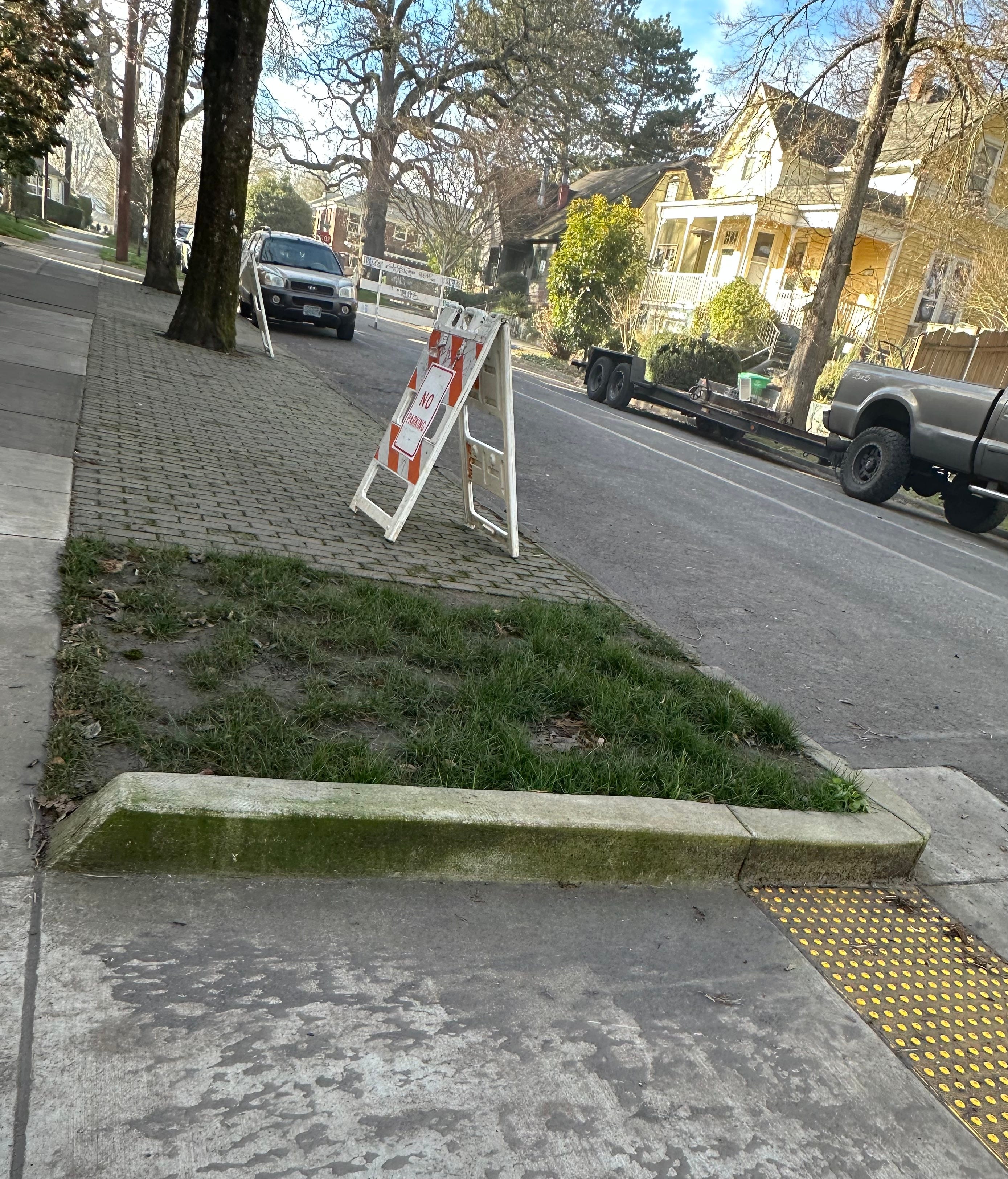
Kitty-corner from this roadwork, the owner of an apartment building had paved the parking strip with bricks around the trees. The city subsequently told him to remove the bricks nearest the intersection. Why, I don’t know. So now instead of neat bricks that are easily swept, he has a little plot of unsightly, weedy grass that looks like badly placed hair plugs.
Really, really old books
I wrote an article for Oregon ArtsWatch about an exhibition of medieval manuscripts at Lewis & Clark College, “Shaping the Soul: Books in Medieval Life.” One image included in my article was Homo anatomicus, from a book of hours printed in Paris in 1516. A book of hours is a compendium of prayers, psalms and devotions meant to be consulted daily.
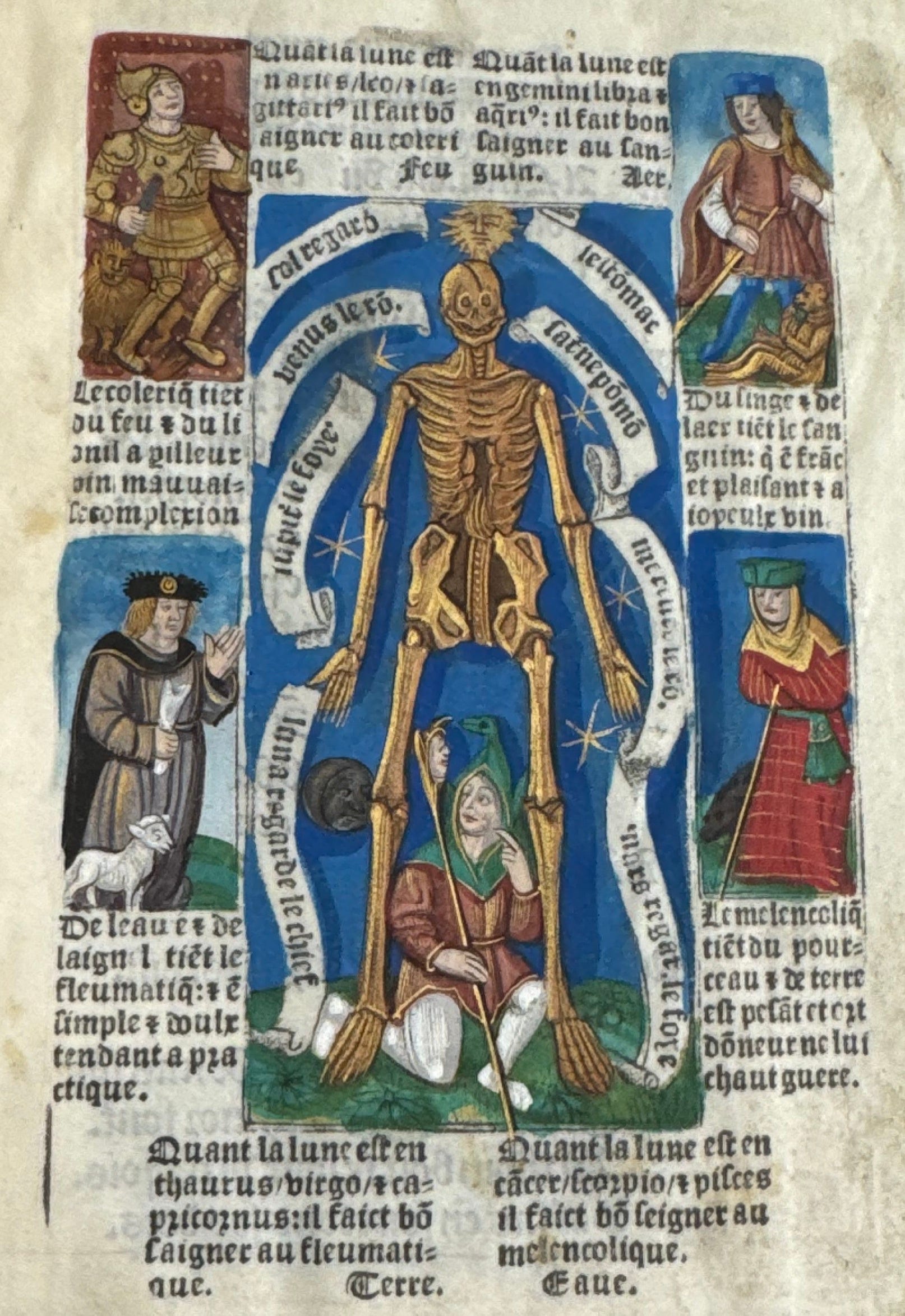
The curators of the L&C exhibit lightheartedly refer to this character as Zodiac Man. In the Middle Ages, it was common to use the zodiac and the theory of the four bodily humors—phlegm, blood, yellow bile and black bile—to time medical procedures such as blood-letting.
Skeletons all around
Skeletal images are usually meant to haunt us, but lately skeletons have seemingly become benign. Since I first wrote about giant skeletons appearing in yards around Portland, I’ve come across dozens more, including a smaller one that just appeared around the corner from where I live.
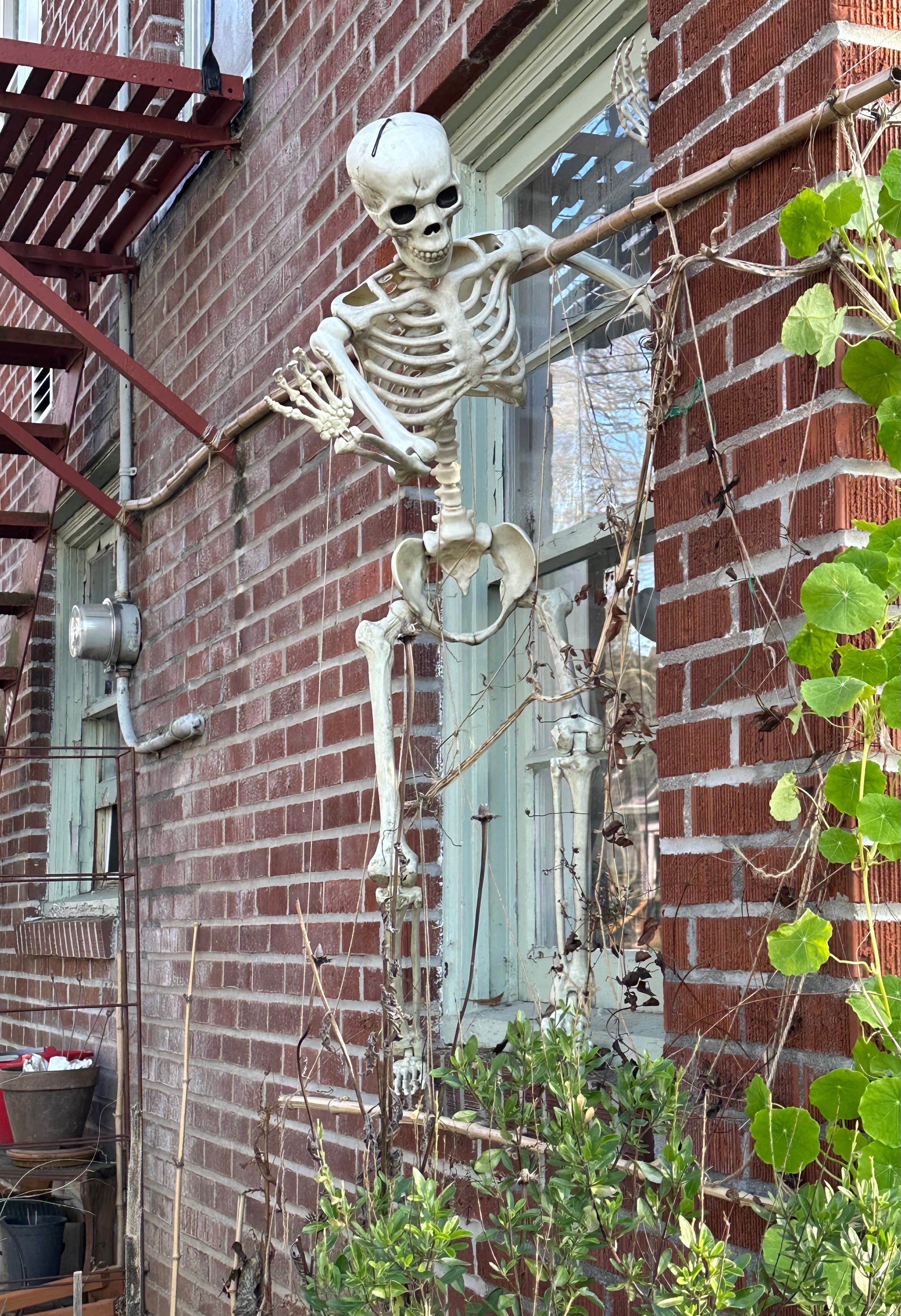
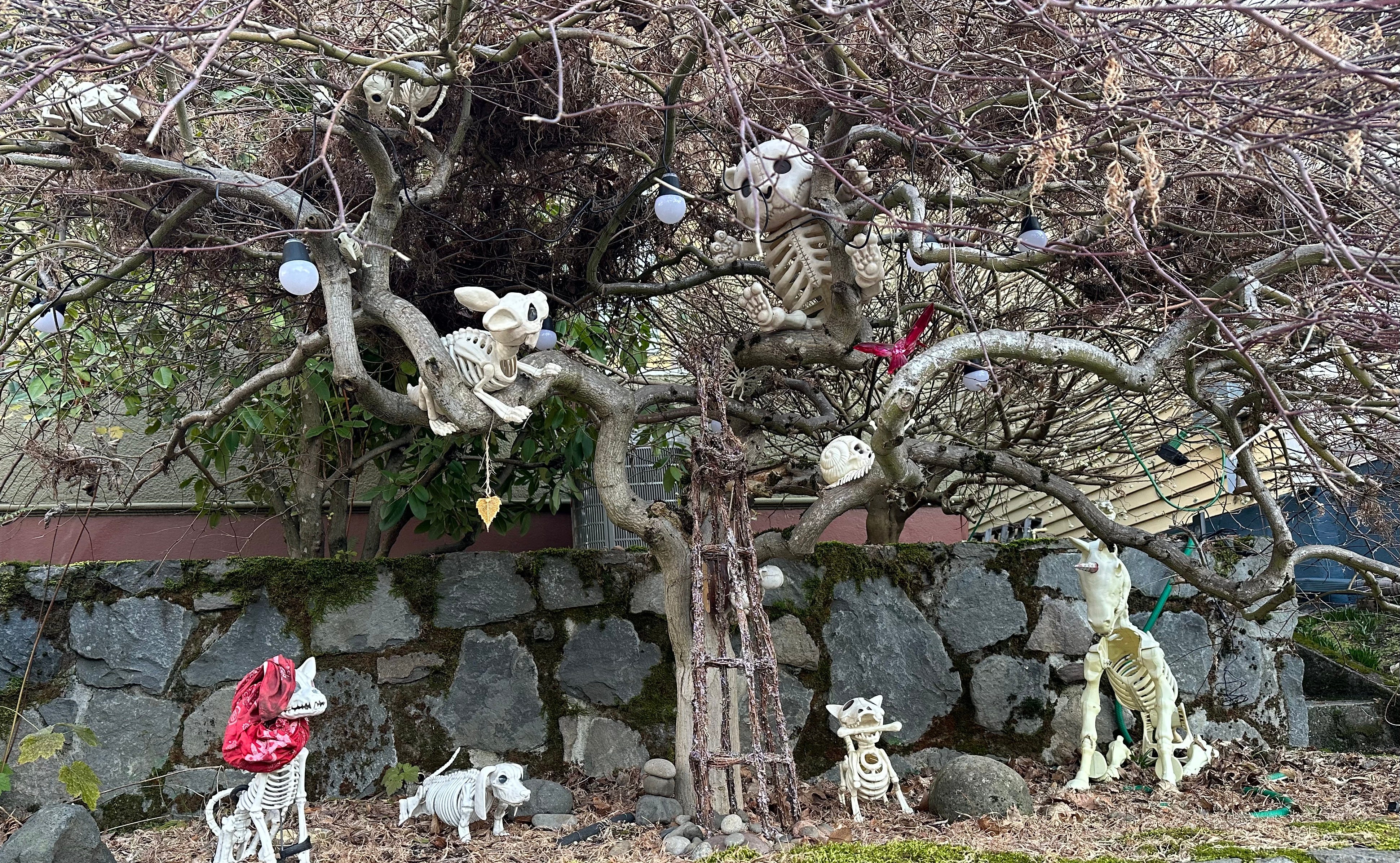
Meanwhile, across the street, my neighbors continue to curate their year-round skeleton collection, rearranging and reclothing the family according to whim and season.
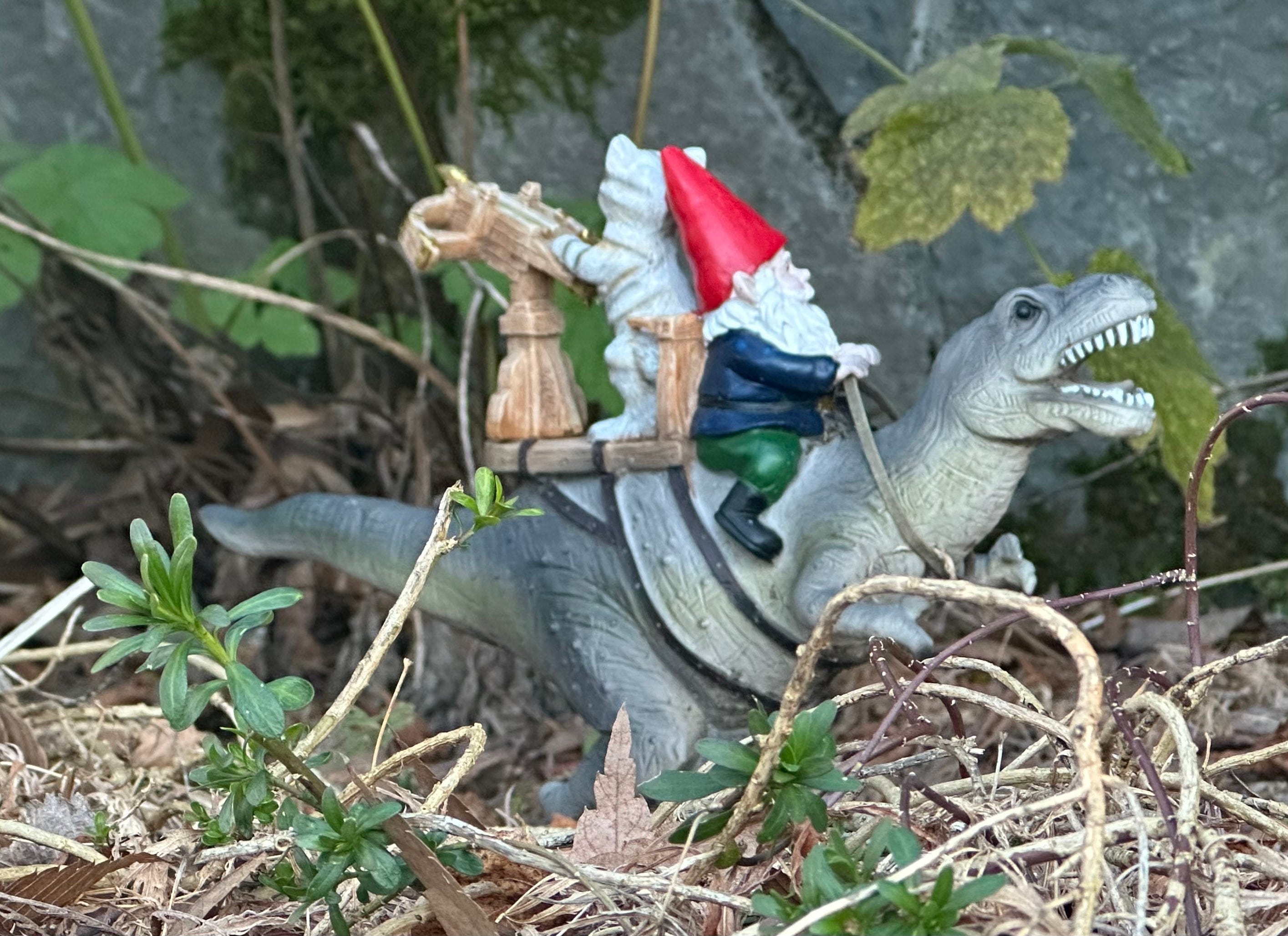
A recent addition, not a skeleton, is a garden gnome riding a dinosaur. The figure on the back is aiming a crossbow.
Pen tech
Back in college, oh, 55 years ago, I discovered fountain pens that used plastic ink cartridges. I loved the fluidity of writing with fountain pens, the gentle cachet. The nibs moved more easily over paper than ballpoint pens.
Then cartridge pens vanished. At least I didn’t see any pens or cartridges for sale until the mid-2010s. Nowadays, a renaissance of pens and ink and fine paper greets those who journal or draw or just try to keep track.
My current collection of fountain pens includes a number of standard German-made Kaweco pens that take stubby cartridges, several stylish and smooth-writing Pilot models, and a TWSBI, made in Taiwan.
I have a hate/hate relationship with TWSBIs. The first one I bought broke right away; the second one is still on probation. TWSBIs are ugly and ungainly pens that you fill with bottled ink—but they hold a lot of ink.
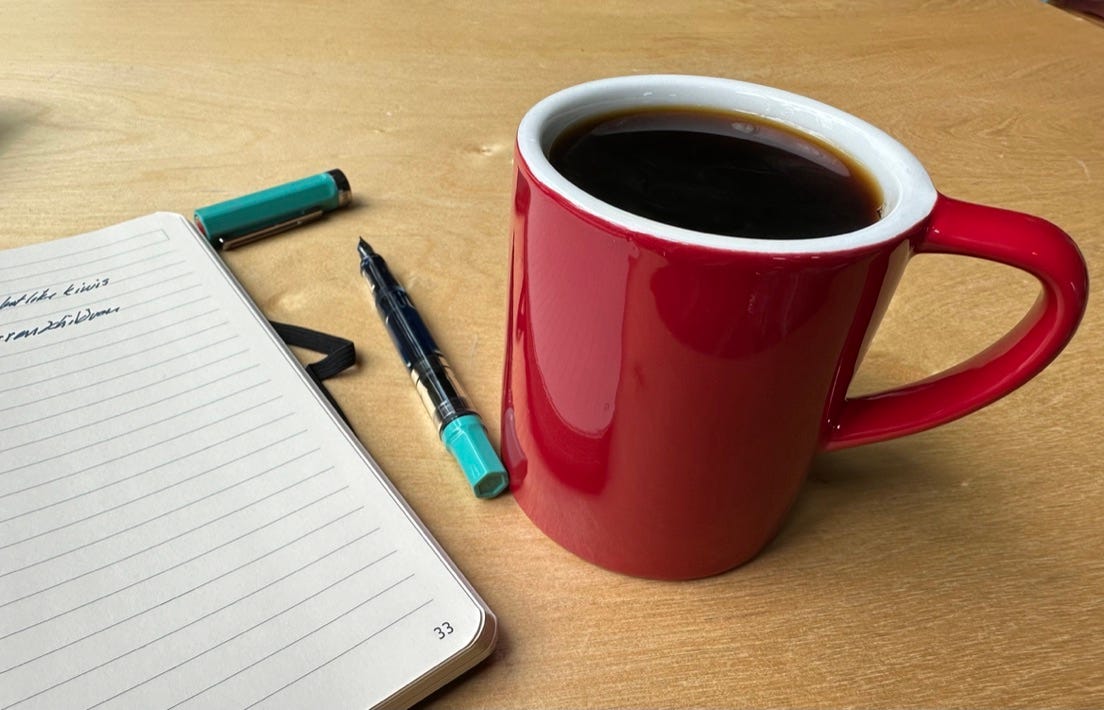
Today’s fountain pens work with either cartridges or bottled ink. Working with wet ink is messy but fun and rewarding. You can use a syringe to squirt fresh ink into an empty plastic cartridge.
The main drawback with fountain pen ink is that it’s water-soluble, so if the page gets wet, the ink runs. (Try not to cry where you write.) It can also bleed through cheap paper, like the kind you find in composition books.
Cancel that
A few months ago, I resolved to start replacing fountain pens with gel pens, which also scoot over the page effortlessly, don’t bleed, and are more water-resistant, not to mention less messy. The ink dries faster, too, so it don’t get smudged if I close my notebook too quickly.
But . . . then I received a great Christmas present, a sweet new Pilot, a big bottle of blue ink and a new syringe.
So, I’m content to be back to fountain pens.
Meanwhile, I found an old Parker ballpoint among my mother’s belongings. It reminds me of her. I was able to find a refill, and I carry it with me on my bus travels, along with the TWSBI and a Kaweco.
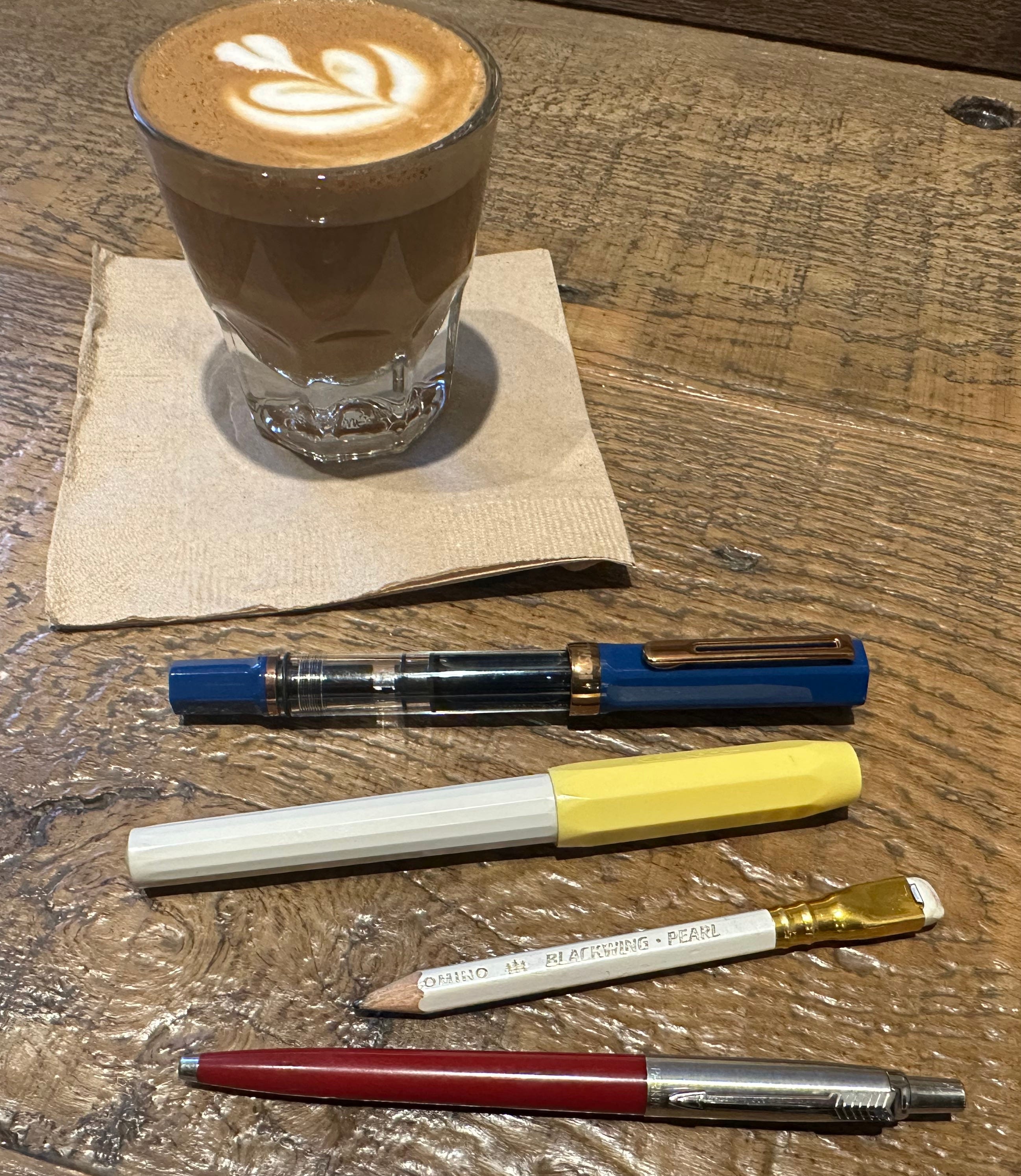
Ballpoints are a great technology. They don’t leak, the words on the page are permanent, and they write effortlessly. They just don’t have the mystique, the cachet, the sensuousness of fountain pens. Ditto for gel pens.
So fountain pens it is! I can always wash the ink stains off my hands.
Check out
Sometimes
Sometimes the world works better.
The seams line up, the pot stays on simmer.
My socks match.
The rain pauses just as I venture out.

Sometimes the milk doesn’t sour.
The cat uses the litter box.
The newspaper lands on the porch
And not in the rosebushes.

Sometimes I see in your eyes
My own worth, a fine reflection.
Sometime I pray, sometimes I search—
Inside my skull, under the bed.

I find things bright and shiny,
Pennies in the gutter, a raindrop . . .
And, sometimes, the smell of a cigarette on a cold day,
Smoked by a man in a slouchy hat.
Till next week
This week, I got a love email from an old friend and new reader of Becoming. I won’t quote the words—that would make me blush—but the missive did remind me to point out that sending me an email is one nice way you can show me your appreciation.
Others are
Liking the post (click the heart icon)
Leaving a comment
Engaging with the comments other readers post
Subscribing
And—the big one—being a paid subscriber. A substantial handful of loyal readers support my work with paid subscriptions. You can join this group of spectacular individuals by clicking on the “subscribe” or “update” button. It costs $50 a year, less than $1 a week. Most posts are about 1,800 words—that’s mere fractions of pennies per word.
Otherwise, here’s the PayPal link if you want to send cash in increments of $5. I appreciate those donations too.
Love you all,
—Fran
—30—
Fran--
I couldn't agree more with your reflections on the confidence writers must find (or manufacture). Find your voice, flex the muscle (write!), and repeat! Thank you, as always, for your astute observations and for how deftly you convey them.
Oh Fran, I love your offerings. I imagine it’s only a matter of time before you discover a skeletal gnome on the streets of Portland. May they always be smooth and ADA compliant. ❤️