Charge!
A baseball tradition, the power of peccadillos and the prettiest bus ride

Check in
Mailboxes
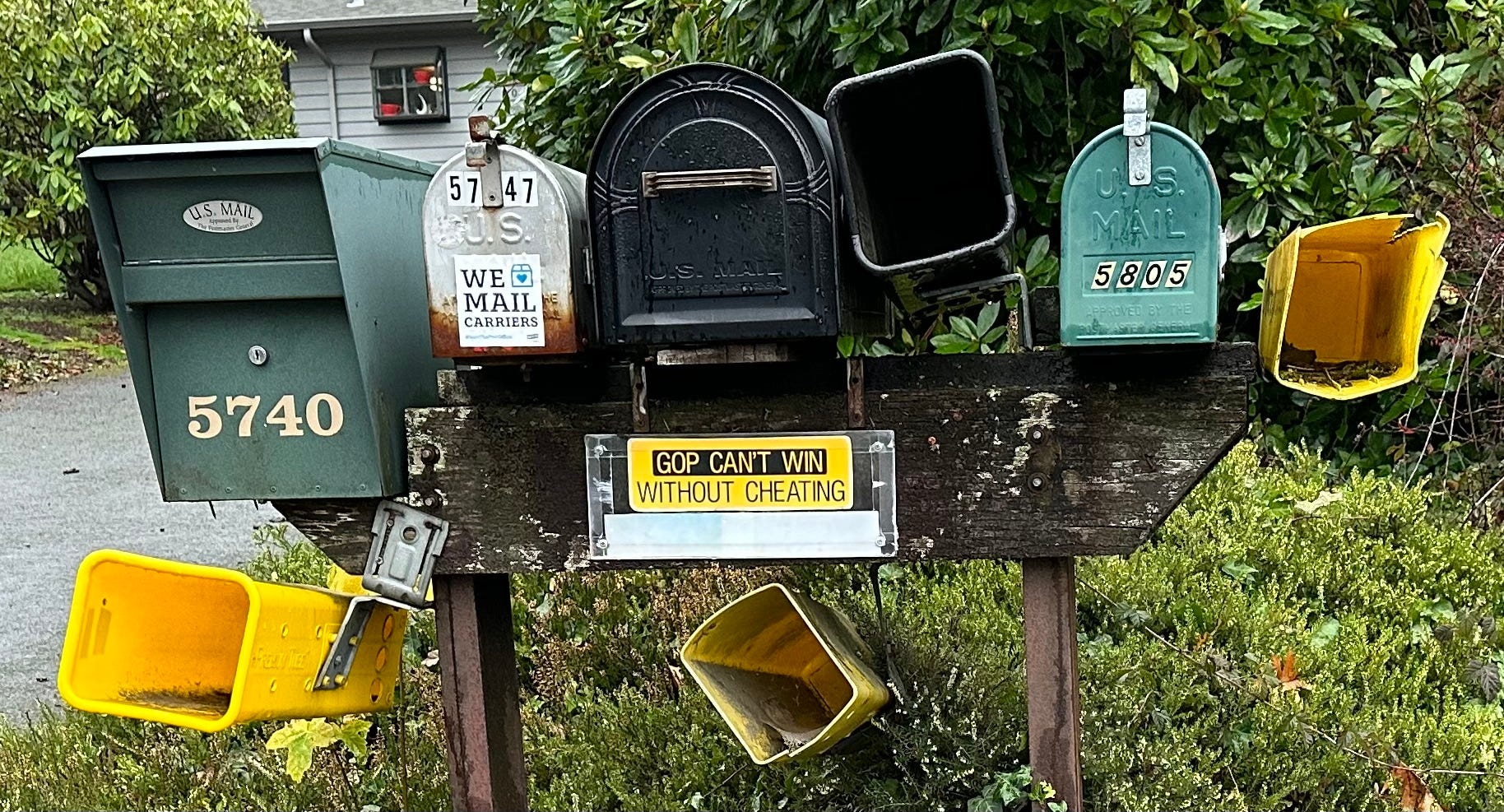
Mailboxes and outdated newspaper sleeves outside a home on a rural street in Southwest Portland.
Fanfare
The World Series ended last Saturday with a home run by Dodger catcher Will Smith in the 11th inning. Pitcher Yoshinobu Yamamoto richly earned his MVP, and I will never forget the extraordinary catch by Andy Pages of the Dodgers in the ninth. He knocked Enrique Hernández to the ground on his way to nailing a fly ball at the wall.
I wonder what it would be like to be among the fans in Toronto. The tiny players on the field, the huge Jumbotron recording the action.
Although I’ve been to my share of minor league games, I have attended exactly one major league game, the SF Giants back in 1972, when I was a student at Berkeley. I remember we smuggled in a thermos of gin-laced hot lemonade. Maybe we yelled “charge” with the rest of the crowd at appropriate times.
At most ball games, the organist plays those six tones and the crowd screams “Charge!” There may be a second or even third iteration, but that’s it. Everyone sits back in their seats and the game goes on.
Wikipedia reports that the fanfare, written in 1946, was first played on-air during the 1959 World Series. The Dodgers were playing in the series, having just moved to California from Brooklyn the year before. They beat the White Sox, 4-2.
Daily charge
I wonder if we could pick up “Charge!” as a daily practice. It’s not like we don’t do it already.
Every day we
Charge purchases.
Charge our electronic gizmos
Charge into new situations, ready to rock and roll
Recharge our psychic batteries after a long day working. Time to nap, drink iced tea or watch baseball on television.
Ask “how do I charge today?” Like “What’s in your wallet?” intoned by the deep-voiced actor Samuel L. Jackson in a current credit card commercial.
Meme of the year
Dictionary.com has chosen a word of the year for 2025 that is a number.
It is 67, pronounced “six-seven,” not “sixty-seven.”
What does it mean? That doesn’t seem to matter. A clip of a tween and his friend waving their hands and yelling “six-seven!” at a basketball game in March tore up the web at warp speed.
This YouTube video purports to explain the meme, but part of the meme’s mystique is that it defies explanation.
Dictionary.com fudges the meaning, saying “Well . . . it’s complicated. Some say it means “so-so,” or “maybe this, maybe that.”
Perhaps the meaning of 67 is that it is meaningless.
Sixes and sevens
Dictionary.com ignores the longstanding phrase “at sixes and sevens,” meaning discombobulated. A similar phrase been around a long time, at least since Chaucer’s “Troilus and Criseyde” from about 1385.
I looked up “sixes and sevens” in Brewer’s Dictionary of Phrase and Fable. This fascinating tome, stuffed with anecdotes about the origin of phrases, was first published in 1870. It’s been updated several times, the last in 2018.
My copy of Brewer’s, from the 1960s, doesn’t mention Chaucer in its entry on sixes and sevens. It cites the Hebrew Scriptures: “ ‘Six, yea seven’ was a Hebrew phrase meaning an indefinite number.”
“He shall deliver thee in six troubles, yea, in seven there shall no evil touch me,” is the King James wording of Job 5:19.
William Sydney Porter published a collection of 25 humorous short stories called Sixes and Sevens in 1911 under his pseudonym, O. Henry.
I’ve always said the phrase as “sixes and sevenses.” It sounds better that way.
Other two-digit numbers
Douglas Adams says he came up with the number “42” off the top of his head as the “answer to the ultimate question of life, the universe, and everything.” He created the supercomputer Deep Thought and its nonsense answer as part of his teleplay “The Hitchhiker’s Guide to the Galaxy.” It took Deep Thought 7.5 million years to reach its two-digit answer.
Substacker Drift Johnson offers a lengthy but fascinating analysis of Adams’ question and answer in a post titled “The Ultimate Answer: Why ‘42’ is Actually Brilliant.” At one point, he notes that 42 is . . . drumroll . . . 6 times 7. As in 67.
He also points out that “in ASCII encoding, 42 corresponds to the asterisk (*), the universal wildcard symbol meaning ‘anything’.”
And a straggler
A more straightforward two-digit number is the basis of an iconic quote from the movie “Bill and Ted’s Excellent Adventure.” When Bill and Ted in the present encounter Bill and Ted from the past (or is it the future?) they are asked what number they are thinking of right now. All four answer in concert:
Most scenic TriMet route
I finally got my wish this Thursday, to ride the most scenic route in the TriMet system. I take the 30 line from the Clackamas Transit Center to the little town of Estacada, about 15 miles south of town down a winding country highway.
Few people ride this bus, and it only runs once an hour. And indeed, there are not many destinations on much of the route. Just the Clackamas River; tiny hamlets like Carver, Barton and Eagle Creek; scattered houses and farms; and trees, trees, trees.
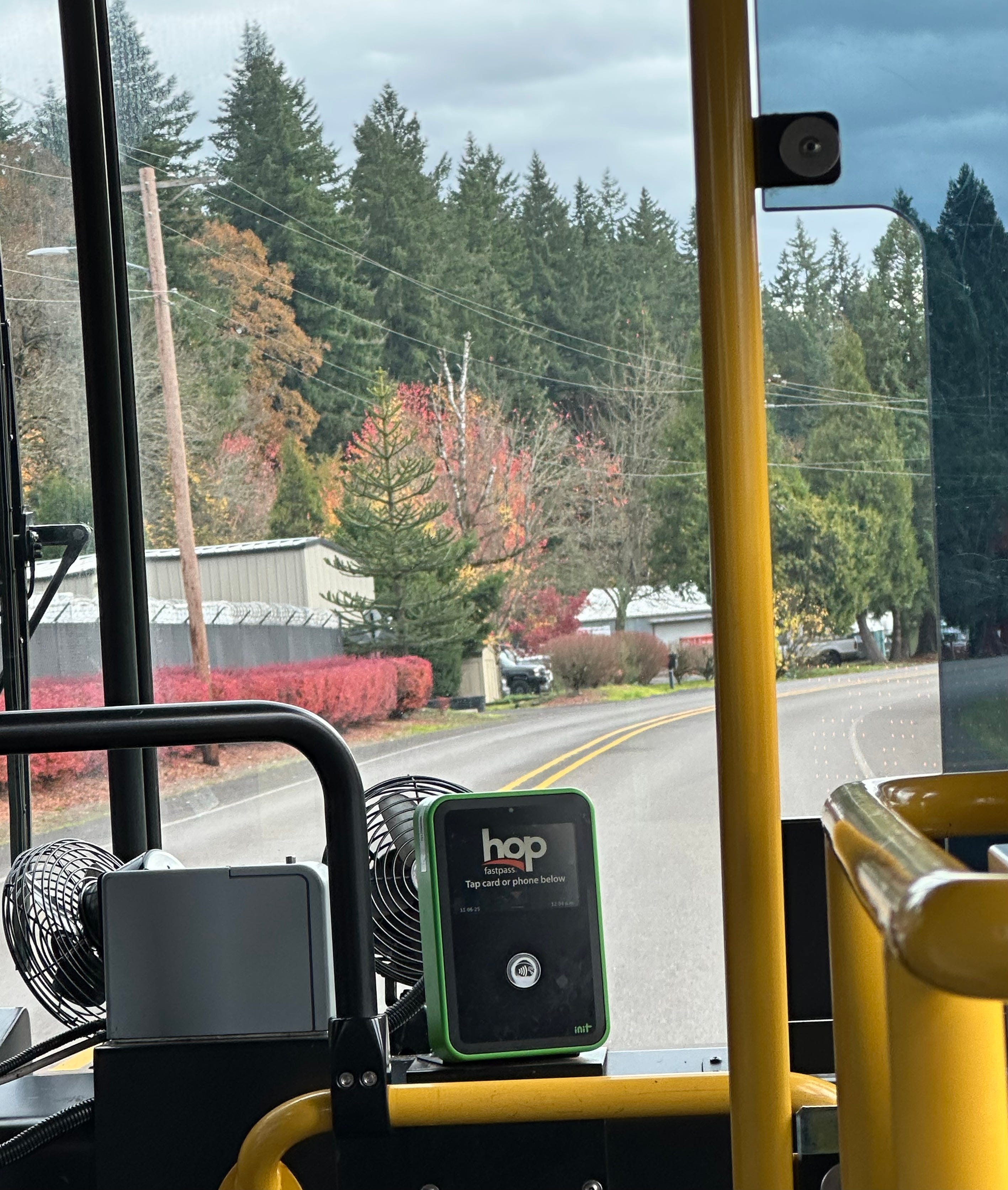
“You should have taken this route last week,” the helpful driver, Tracey, tells me. “The foliage was gorgeous then.”
Like, yeah. I know that. I was setting out to take the Estacada bus on Halloween when I lost my cell phone at a MAX station. It took five days to get a replacement phone, but as soon as I have it in hand, I am off to Estacada.
Starting in suburbia
The first third of the drive is disappointing. Close-in Clackamas County is a maze of three-digit highways I’ve never been able to untangle: 211, 212, 213, 224. The 30 bus travels on Oregon 224, the Clackamas Highway.
The view from the bus at the outset is mostly cars and more cars zipping past light industry, strip malls, taverns and the ginormous Fred Meyer distribution center.
Eventually, though, the commercial build-up diminishes, changing to a landscape of small farms with grazing sheep, tree farms and then forest. The Clackamas River falls away to the right. The road twists gently through hilly terrain, providing vista after vista of fall color—mostly yellow now.
At Eagle Creek, about 10 miles in, the landscape changes. The trees are less stately, more scrubby. We pass mobile home parks, barns and paddocks (but no horses today).
End of the line
Oregon 224 leads finally to Estacada. This small city gives an impression of flatness: level ground and one-story houses, garages and businesses, some with very mossy roofs. The only multistory buildings are new apartment houses, and gatherings of heavy equipment on two sites show where more new apartments will rise soon.
Past a large library, the bus draws up at a tiny, rustic city hall.
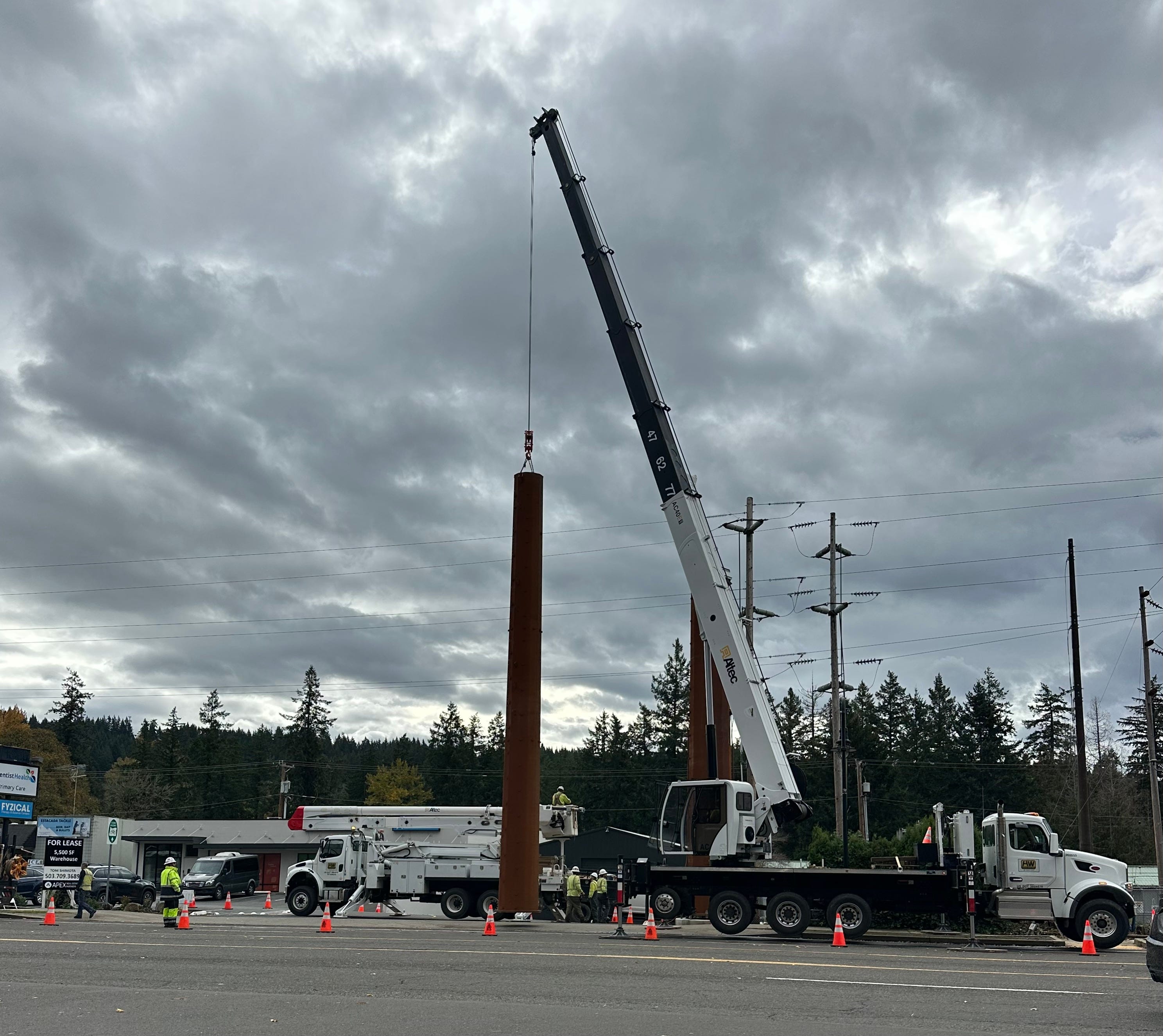
The layover is only eight minutes, so I don’t have time to explore. I ask the workmen across the highway what the huge iron conduits are for. They are to hold electric cable. There’s a major substation there at Clackamas and Main.
Back to town
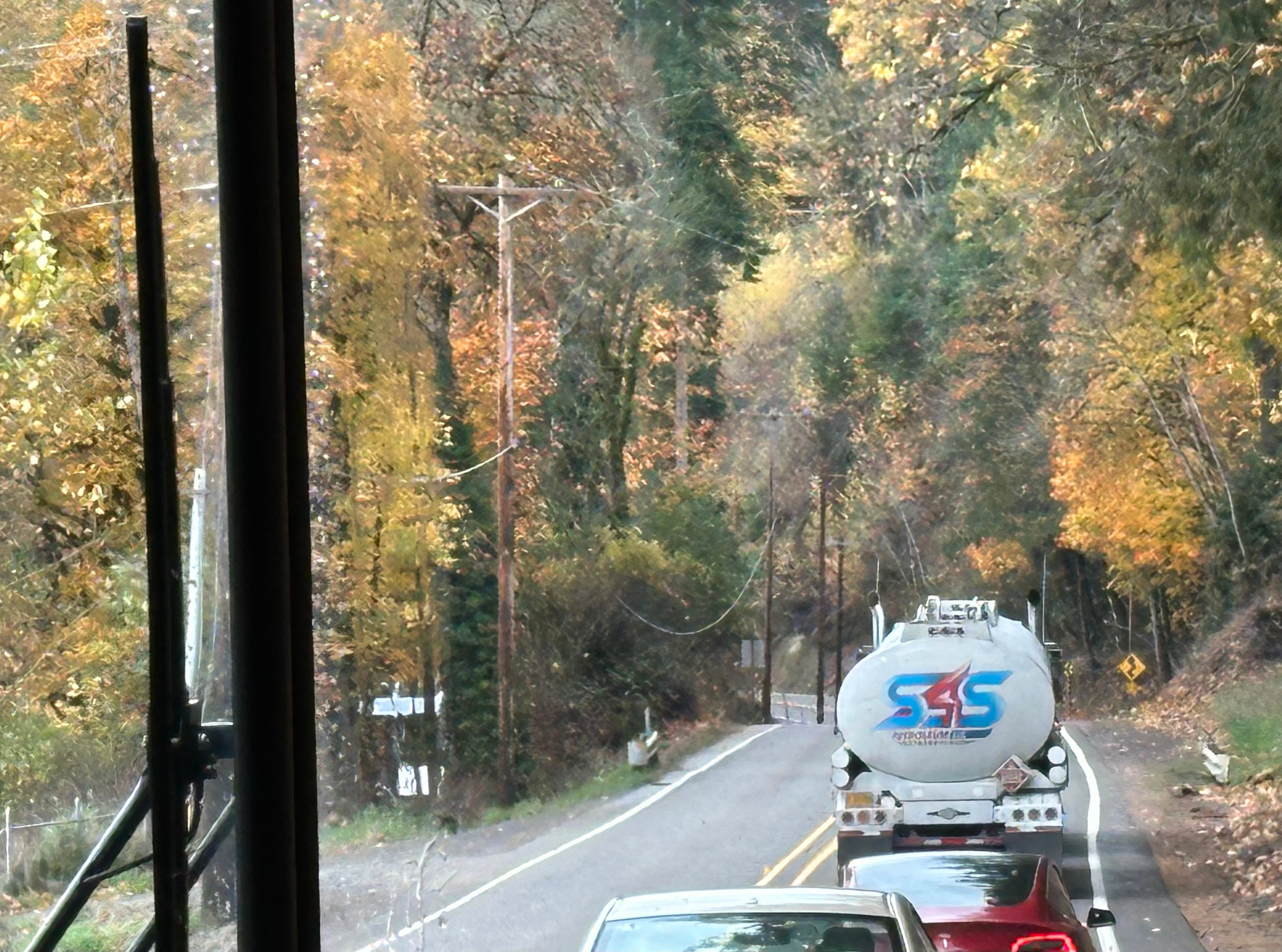
On the way back, I spy a resplendence of red maples outside a house on a bluff. And I glimpse of a pile of clipping, a tangle of upturned roots. For some reason, that image really moves me, a pile of dead vegetation in the middle of a green field.
Peccadillos
I have enjoyed a Substack posting by Joy Sullivan, titled “Becoming the villain you always needed.”
In this posting she extols the pleasure of simple villainies, little jabs against the system.
For example, she shares that she secretly crunches some of the chips at the bottom of a bag at a supermarket before replacing the package on the shelf.
There’s an old-fashioned word for a little offense like this: peccadillo. It’s a Spanish term that derives from peccare, Latin for “to sin.” (Not to be confused with peccary, the piglike South American animal, into which spell check tried to change the Latin word.)
Peccadillo is a cute word for what Joy argues we need more of, the out-of-school thrill of little, purposeful misdeeds.
Here’s one that I do:
When I’m out in the wheelchair, I carry a pair of garden clippers with me. Sometimes bushes or trees or other greenery grow out over the sidewalk. That’s when I whip out the clippers and snip away. I leave the clippings lying on the sidewalk.
Sometimes I channel the glee of the silent Harpo Marx with his oversized scissors, seizing men’s neckties and chopping them off.
I’m not sure that what I do is a peccadillo; I’m just making a statement and cleaning up the neighborhood at the same time.
Have you any peccadillos of your own? Leave a comment here—or at Joy’s Substack,
My shaggy pony
The pony of my poetry grows shaggy
Because I don’t go back and groom it.
Braid the mane and brush the coat all over
Trim the hooves and set them on the path.

Ponies are for playing more than riding,
Straddled, my long legs, braces-clad,
Brush the ground, rumble over pebbles—
Better to walk, if walking would suit me.

What suits me is to sit in my recliner,
Wrapped in soft memories and lore,
Holding a pen away from the paper,
Keeping the thoughts inside me, dried away.

Not every impulse will have its day.
Not every emotion will be explored.
Nothing of me will ever really exist
Beyond today.
Check out
Tedeset
The huge Gateway Fred Meyer store on Northeast Portland’s 102nd Avenue closed in September. About the same time, on nearby Halsey Street, a small Ethiopian market opened.
It’s called Tedeset Market and Cafe. The owner’s name is Merhawi: “Call me Howie.”
This store is a source for Ethiopian grocery items. Jars and packages of spices, seeds and sauces needed for Ethiopian cooking neatly line shelves. You can buy a 25-pound bag of teff flour, used to make spongy injera bread, an Ethiopian specialty.
Besides the Ethiopian grocery items, Howie offers variety of tasty samosas, made locally. His excellent coffee is roasted by a small local business. A cappuccino set me back just $3.
Howie cares deeply about his venture. I hope he succeeds.
Kiyokawa
I spied this hand-lettered produce truck on Northeast 122nd.
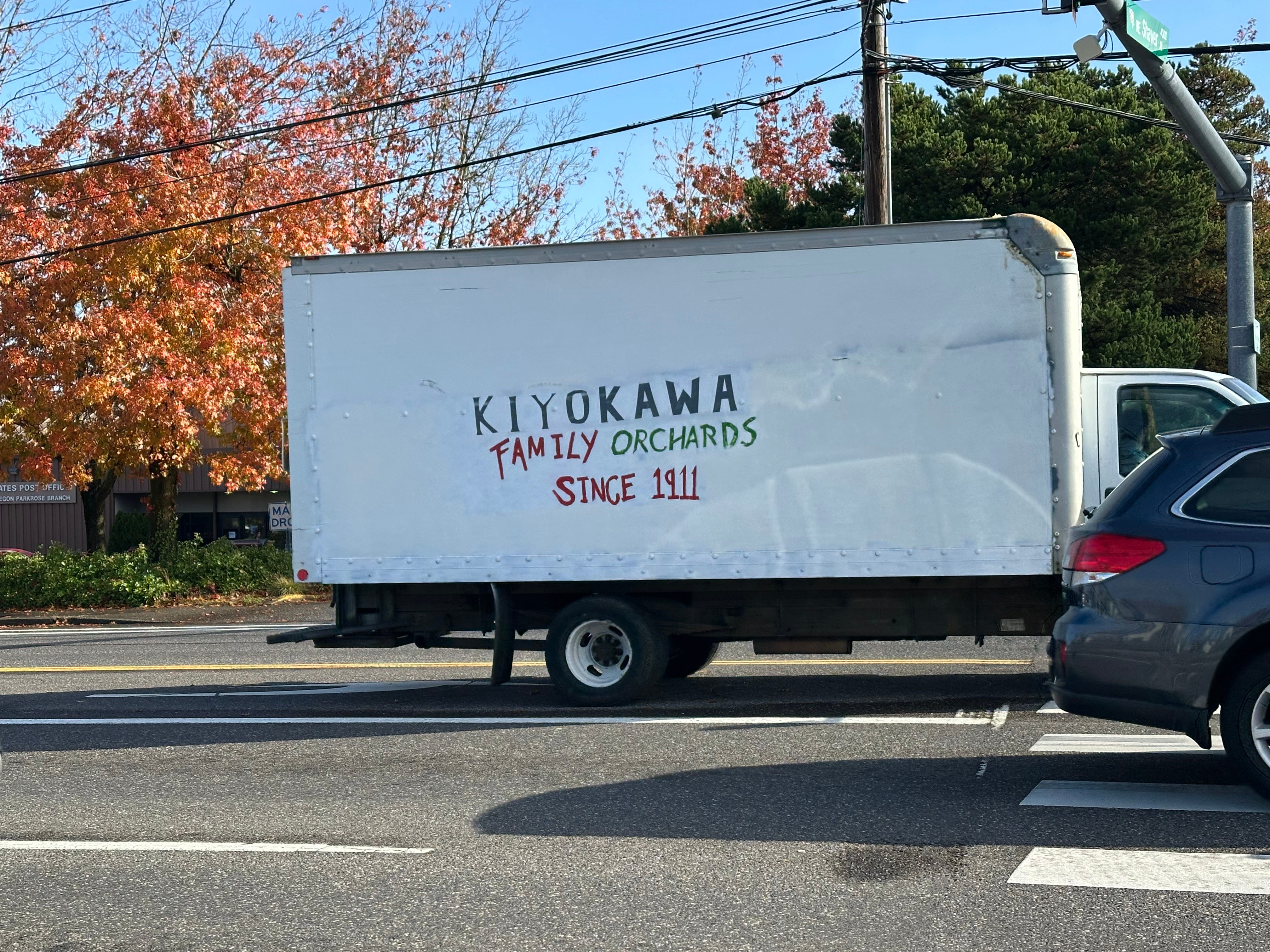
Kiyokawa Family Orchards is in Parkdale, in Hood River County, home to truck farms and fruit orchards. The current owner is Randy Kiyokawa. His website describes how his parents met in an internment camp, to which Japanese U.S. citizens were sent during World War II. His dad was in military intelligence at the end of the war. His mother has turned 100.
The business operates a fruit stand in Parkdale through Nov. 23, and they sell on Saturdays at the Hollywood, Lake Oswego and PSU farmers markets. On Sundays, find them at Lents, Montavilla and Woodstock.
Literary Arts
The Portland Book Festival was today, Nov. 8. As my part of it, I wrote about a poet, Mai Der Vang, and her wonderful book of poetry, Primoridal, for Oregon ArtsWatch.

The poems in this collection revolve around the saola, a gazelle-like creature of the Laotian Annamite mountains, where they were hunted by the Hmong. No one has seen a live saola in many years; they may be extinct.
Vang grew up in a Hmong community in Fresno, Calif. This is her third published collection of poems, and it is masterful and immersive.
Till next Saturday
Here’s the usual reminder to “like” this post or comment on it. I’ve been really enjoying the give and take of comments over the past weeks.
Paying subscribers don’t get anything special besides knowing that they support my work, and, actually, that is HUGE. Thanks to all readers for making me feel that what I write is worth reading.
—Fran
—30—
Thank you for the brilliant post. I especially liked your thoughts about the present and past meaning of six and seven.
Wonderful synopsis of line 30 Fran. Urban industrial sprawl has made the westerly section less appealing these days. Glad you made the journey. I did drive that route one icy winter in the dark. Talk about stress!!
My all time favorite route is the 63, which travels up through Washington Park, the Rose Garden and Japanese Garden. I call it the "happy bus"because most of the ridership are tourists ;-) I'm also quite fond of line 16 because driving over the St John's Bridge 16 times a day is nothing more than delightful!